
‘FBI’s Roland Buck III & Writers Explain Isaiah’s Secret & OA’s New Conflict



Spoiler Alert
What To Know
- The latest FBI centers on Isaiah, who ends up a murder suspect and has a major secret revealed.
- Roland Buck III and the episode’s writers, Bryce Ahart and Stephanie McFarlane, break down the episode, including Maggie and OA’s new dynamic.
FBI explores mental health in a major way with two of its agents, OA (Zeeko Zaki), back with the team after being undercover to take down Anna (Claire Coffee) and her strike team, and Isaiah (Roland Buck III), Maggie’s (Missy Peregrym) partner while OA was gone and now at the center of the Monday, October 26, episode’s case. TV Insider spoke with Buck and writers Bryce Ahart and Stephanie McFarlane. Warning: Spoilers for FBI Season 9 Episode 4 ahead!
To the team’s shock, while investigating a carjacking and baby abduction connected to a murder, the DNA at the scene comes back Isaiah’s — and the victim is his ex-girlfriend. As they learn during the investigation, he’s on meds for bipolar disorder. He insists, however, that he didn’t kill anyone, and Maggie promises she believes him, She’s right to, as it turns out that the murders — another body turns up — are work- and financially motivated. Still, Isaiah needs help, and his uncle, ADIC Green (Curtiss Cook) assures him that he’ll be by his side to ensure that he gets it because family always comes first.
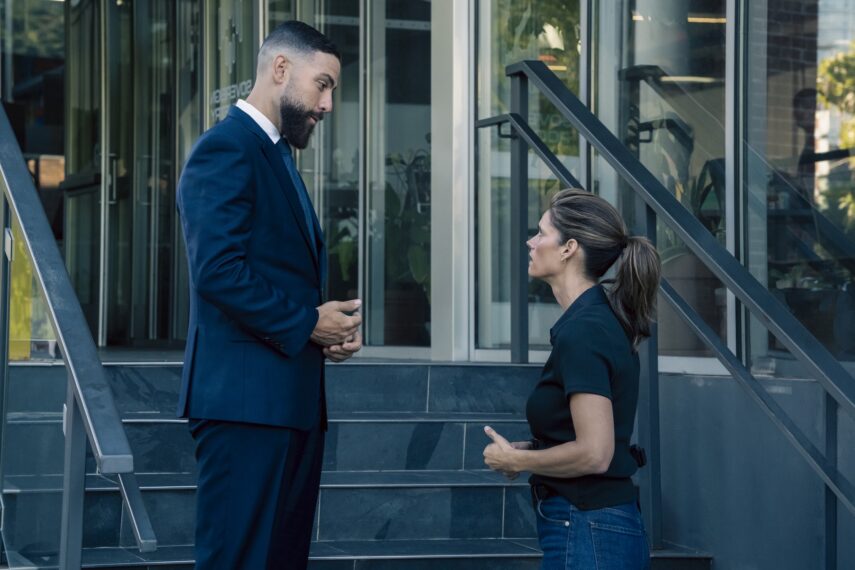
Meanwhile, OA’s not sleeping, as Zara (Pardis Saremi) notices, and he’s acting differently at work, as Maggie picks up. (He refuses to promise they’ll find the baby after he was unable to save the last person he said he would.) But he brushes off any concerns and doesn’t open up about what he went through with the strike team to Maggie. Zara thinks he is, however, and OA interrupts before Maggie can tell her that he’s not.
Below, Roland Buck III and writers Bryce Ahart and Stephanie McFarlane break down the episode.
Bryce and Stephanie, why this story with one of the agents and why Isaiah?
Bryce Ahart: Well, it actually started off with the kernel of an idea. Every episode of FBI, the writers come in with the seed of an idea we wanted to do. And Stephanie had been wanting to do an episode since last season where we are saddled with a character who wakes up in a situation that is completely unrecognizable. They look like they’re implicated in a crime, and then they make a knee-jerk reaction to just run from said crime scene. And we started talking about all of the various ways to tell that story, specifically once you find out that the suspect is a Black man and all lines need to be pointing towards him being the culprit. How would we tell that story in a way that our agents wouldn’t be committing the sin that we’re trying to expose, which is sort of like how culpable is a Black man just by being Black and being at the wrong place at the wrong time?

Bennett Raglin/CBS
Mike [Weiss], our showrunner, came into the room one day and was like, “I think, what if it’s Isaiah?” And then he just left. He comes in, he says it for five seconds, and then he just leaves. And he was like, “What if it’s Isaiah?” And then he just leaves.
And then after we started talking about it five or 10 minutes, we started to think that that was a great window into the story that we wanted to tell. We started to think about all the different permutations of conflict. You’ve got the ADIC, you’ve got Maggie, you’ve got OA coming back from his stint undercover, and it just felt like the well was just full of different directions we could tell.
Stephanie, of your original idea, how much of that actually came to fruition in this episode? How much changed?
Stephanie McFarlane: To be honest, my idea was literally just that kernel that Bryce pitched. So that stayed completely the same, which I’m happy about. Also, the POV was a part of it as well. So that stayed the same. So I’m really happy about that. And the rest of it was expanded beautifully by the room, and then obviously Roland’s performance as well.
All of you, talk about the conversations you had about the storyline for Isaiah.
Ahart: Well, I think in terms of this episode, I don’t think Roland actually found out about his character’s mental illness until this episode. We talked at length in the room about what’s the best way to platform his character. Do you present him as sort of ailment first or agent first? We thought, well, let’s just let the audience get to know him, his character, his skillset, his relationship with Maggie first and foremost, and then do the rug pull. I think that was the way, because I think when we were talking about it with Mike, we were like, we want the audience to be really in the same position as Maggie, which is holding onto the humanity that they got to witness in Isaiah for the first three episodes so that when they’re given this revelation that, oh, he’s on mood stabilizers, antipsychotics, he’s had this troubling relationship that didn’t go his way, that it’s balanced by the good that you do know about him, that you’re able to at least sit with the story long enough until we find, OK, he didn’t do it. And we all can sigh in relief with that. And then Stephanie and Roland can talk more to what they discussed on set.
McFarlane: Yeah. I mean, when I got to New York, me, Roland and John Behring, who directed it, we all sat down and we gave Roland the space to talk about the script, talk about the scenes, talk about his instincts and how he sees Isaiah, the type of performance that he wanted to bring to it, the emotion. I think a lot of that meeting was us discussing emotion and just making sure that we tell the story in a grounded way, especially because it involves a lot of different elements. I mean, it involves mania, it involves violence, it involves… And so a lot of it was like, OK, how do we portray this in a meaningful, thoughtful way, which Roland can talk more about that.
Roland Buck III: Yeah. We just wanted to make sure, first and foremost, this is someone’s son. It’s the humanity of Isaiah, because it’s going to be a representation of — it’s a character, but it’s going to be a representation of someone’s son, someone’s nephew. So just the particular circumstances that he’s experiencing, what would someone in that situation do, and how would they respond from a humane place? For the mania, it was more of he doesn’t lose his intelligence, he doesn’t lose his skillset. He’s not crazy. He’s just in a very heightened level. It’s not like I’m moving too fast, he’s moving too fast as everyone else is moving too slow, and the clock is ticking, and he needs these answers because in that manic state, you don’t see that there’s anything wrong. It’s only after, once you’ve come down and you’ve reflected, that you can see the choices you’ve made were —they didn’t have a filter on it, basically. There was no filter. And what would you do if someone that you loved was in that position and you want to, need to find answers? So he took all these skill sets that he had and took the investigation upon himself, which I think people watching could put themselves in his shoes and totally agree that there’s someone in their life that they would do that for.
Roland, what did it mean to Isaiah that Maggie believed him and wanted to help him so badly, especially considering how that partnership started out this season?
Buck: Oh, that meant everything. That meant everything. I think that when he heard that, it was a surprise. But yeah, that and also the ADIC, his uncle, those were seeds of hope in a bad situation for sure. But yeah, he really wanted to prove that he was a viable partner; he wanted to earn her trust, and that he just wasn’t someone that was put there by the ADIC, family ties type stuff. He was capable, and he had her back, and the fact that she had his back, and when it didn’t look good at all was great.

Yeah, you brought up Isaiah and his uncle because ADIC Green said he always comes first, but it almost seems like Isaiah knew that would be his response, given he said that he didn’t want to mess up anything he had going from at the bureau. There was part of him that knew that his uncle would have his back, right?
Buck: Yeah, I think as family, you have that. It’s more of that he doesn’t want to shame him or put a stain on his name. He’s the ADIC, and he’s gotten this opportunity, and he’s grateful for it, so he doesn’t really know how to ask for help in this situation. It’s very complicated. So I think deep down he thought he would, but in our community, sometimes you don’t see us asking for help as much. You got to stay strong and weather the storm and all these things as a man. So the fact that he’s open and says that he could have come to him is a big thing that I’m glad we were able to get on screen for people to see.
Because it’s almost like he didn’t want him to have to make that choice.
Buck: Yeah, you’re not alone. You’re not alone. You think you are, but you’d be surprised and you need help in this world. We all do. You can’t be the rock forever. You need someone else to hold you up as you get stronger. So I’m glad we were able to see that because I’ve never seen that portrayal on screen ever.
Yeah, I feel like ADIC Green has just kind of been subverting expectations this season last week with the Anna of it and him being on the team’s side, and then this week even first him saying to treat Isaiah like any other suspect and then being that caring uncle in that last scene.
Ahart: We wanted to show, first and foremost, just how he’s always trying to balance who he is as an ADIC and the missions he has to serve to the boys upstairs and how our characters, Isobel [Alana De La Garza], and how the people who work under him interact with him. I think historically in our show, the ADICs are always the thorn in the main cast side. I think with ADIC Green in general, just from last season onward, we wanted to show a more, again, grounded version of what it’s like to be the boss. Obviously he has different things he’s conceding with, and sometimes that puts us in conflict, but sometimes because he maintains the same values as us, we’re in lockstep.
I think in this episode in particular, it was interesting to see the veneer of his title sort of fall, and you see him as an uncle in the episode. I think what’s so interesting about the scenes with Jubal [Jeremy Sisto] and Isobel and ADIC Green, or just all of our characters with ADIC Green, is they’re actually talking to him as Isaiah’s next of kin and loved one. And so I think what’s so interesting about those things is they have a different energy. There’s a different feel to them where it’s Isobel and Jubel being like, “So we’re going to run with this investigation, but we can also do you a solid.” And he’s just like, “No, just kind of do it the way you normally would and by the books.” Yeah, I think we’re constantly trying to figure out what is the choice you expect ADIC Green to make, and then is there a viable role for him to make an unexpected choice? And then how do we get there?
McFarlane: Yeah, I think in the episode we do arc towards ADIC Green taking off the ADIC jacket a little bit because by the end, when you asked that question, the scene that came to mind was that scene where Jubel and Isobel, they say, “We found Isaiah, we tracked the cab to this park,” and he says, “I’m out of here. I’m just going.” And I remember even writing that scene, when I was writing that scene, I wasn’t thinking about, what would ADIC Green do? I was like, “What would my dad do in this situation? What would my own father do? What would my uncle do? What would my family do for me if it were me?” And I was like, “Yeah, they would just leave.” And so that was kind of what we wanted to do was arc him towards taking off the ADIC title and being Uncle Lawrence.
Will we see Isaiah again after this episode?
Ahart: We can’t confirm or deny, but never say never.
Roland, do you think Isaiah would’ve opened up to Maggie if she’d been more welcoming from the start?
Buck: No, I don’t think so. I think he did the best he could in that situation. I think he would’ve made the same exact choice, and it wasn’t necessarily about — It was just about finding out who did it, who killed the love of his life. He just had a second chance. I’ve had experiences where you wish you had a second chance with an ex, you don’t get it. Just imagine if you did, and then this has happened. So no, I think he would’ve made that same decision, if anything maybe opened up to the ADIC, but that’s still complicated as well with implication. He’d rather just take it all because it’s worth it. It’s worth it in this moment to find out who did it.
Yeah, and he didn’t want to risk telling anyone about his diagnosis, it seems, because he didn’t know what the fallout could have been.
Buck: Right, right, correct.
Bennett Raglin/CBS
Bryce and Stephanie, you also started building the aftermath of this undercover op for OA, and we’re seeing how that’s changed him. We’re seeing him keeping things, we’re seeing a distance between him and Maggie that we are not used to seeing at all. Can you talk about why you wanted to build that in and what we’re going to be seeing from him that you were building towards with this episode?
Ahart: Yeah, I think in particular, OA, because of the loss that he experienced in the first episode of the season where he sort of promised a man he’d save him, didn’t make it back in time, we’re dealing with a grimmer OA who’s a little bit less hopeful. I think the three months he spent with Anna Vorpe, he’s been to far dark corners of the world and has witnessed unspeakable things. We got to see some of that in the first three episodes of what he was being tasked to do. And so I think the actual conflict is the OA that is coming back in 904 and the OA that used to be is the real conflict. I think Maggie is expecting OA to revert to type. So that’s why when you have a scene where they’re talking to the mother of our missing baby and OA doesn’t console her in the way that we’re sort of used to seeing him console her. I think that is very jarring to Maggie and those kinds of moments create conflict.
But I don’t think OA’s issue is with Maggie or his animus is with her. It’s more so about… I think it’s so interesting because I feel like you can connect OA and Isaiah in this episode. Both are unwilling to come clean about something that is ailing them to people that they love. For Isaiah, it’s his uncle. For OA, it’s Maggie. If anything, this is just first us planting a flag on the ground for the audience is that you’re going to see a very different dynamic with our main duo this season.
What can you say about that dynamic? And what are you enjoying writing with having them out of sync with each other in that way? Because it’s so different than we’ve seen all series.
Ahart: It’s finding conflict in areas where you wouldn’t normally otherwise find conflict. Sometimes it’s not going to be they have opposite views on a suspect. Sometimes it’s how do we go about getting the suspect or what is the right way to do something? OA’s coming back with a heap of lessons from Anna Vorpe’s side. Does Maggie want to take any of those tricks into their arsenal? It’s just little things like that where he’s coming back a completely different person. And respectfully, Maggie’s also a completely different person. She suffered a big loss last season and she lost her guy for three months while she was processing said loss. So they’re both, I think, finding their footing back to who they used to be, and I think it’s going to be an interesting journey for the audience this season to watch them struggle, but it’s not going to be all doom and gloom. There’s still laughs. They’re still OA and Maggie, but it’s going to be a little bit kinetic this year.
McFarlane: Yeah. I definitely think it was fun to write them a little bit at odds, only because it felt like in our episode, Maggie had two partners. She has Isaiah, and then she has OA back. And there was times where we were talking about how Maggie must feel like, “OK, I’m supposed to know both of my partners like the back of my hand, and in this episode, I feel like I don’t know either of them.” And that was really fun to write, because as you said, that’s typically stuff that we don’t do.
I love the Maggie and Zara moment that we got at the end, so thank you for including that.
McFarlane: Yes!
FBI, Mondays, 8/7c, CBS

Let Us Be Your JOC
Get absolutely everything about FBI in your inbox!












Conversation3 Comments
Please read the TV Insider Community Guidelines.
Register or sign in to join the conversation.
-
J
I'm kind of bummed that the writers did this to Isaiah. He could have been an interesting character, interacting with the team in different ways. Now we'll never see him again, certainly not as an agent.
-

Why did you guys just throw OA and Zara into the sack together? They had what one date last season? I just cannot figure out why you guys keep running from any more closeness between Maggie and OA?? Zara isn’t necessary a bad character, she’s just not developed and it feels like a Mona or Gemma situation. It would have been so much better to have OA and Maggie figure out their respective trauma together. Come on FBI writers. You can do better.
-
J
On one hand I agree with you. It was only a matter of a day or two (I'm guessing) since OA has been back in NY, so that seems a little premature for them to just jump into bed together. I would think that Zara would have some reservations about it, as, up until the very last moment, she was under the impression, as everyone else was, that OA had been fired from the FBI and simply dropped off the face of the earth. I know that if I were Zara I would have questions.
On the other hand, we only *saw. OA & Zara on one date, but that doesn't mean more didn't happen between then and the time that OA dropped off the grid.
In any case, I think the main reason that scene of them in bed was included was to let us know that OA isn't opening up about his undercover experience, and that he blames himself for not saving that guy, and that he's basically having some difficulty reintegrating himself back into normal life. We--and now Maggie-- know that he's just not talking to anyone about the whole thing, and I believe that's the takeaway that we're supposed to have.
-