
‘The Audacity’s Sarah Goldberg on Why AI Won’t Kill Hollywood




What To Know
- Sarah Goldberg discusses her role as JoAnne, a morally compromised therapist in AMC’s Silicon Valley satire The Audacity.
- The show satirizes the world of tech billionaires and America’s wealthiest class.
- Goldberg expresses optimism that, despite AI’s growing influence in Hollywood and beyond, human creativity and the desire for authentic connection will win.
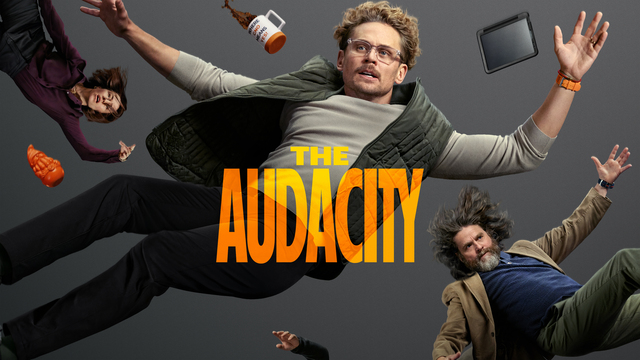
Sarah Goldberg plays a morally grey therapist in The Audacity, the new Silicon Valley satire from Succession writer Jonathan Glatzer that’s already been renewed for Season 2. Here, the Barry and Industry alum unpacks how taking on high-profile clients such as neurotic tech CEOs Duncan Park (Billy Magnussen) and Carl Bardolph (Zach Galifianakis) slowly but surely chipped away at her integrity to the point where she started insider trading with intel she banked in therapy sessions.
JoAnne’s scheme ultimately pales in comparison to the surveillance and insidiously thorough data mining that Duncan’s company pulls off. But Duncan, her most annoying client, is using this intel to blackmail his shrink. In the TV Insider exclusive clip above, he tells JoAnne to give him the name of a client who might invest in his failing company, Hypergnosis, or else. JoAnne names Carl. Find out what happens next when The Audacity Episode 2 airs this Sunday, April 19, at 9/8c on AMC. The episode is streaming now on AMC+.
Below, Goldberg talks about The Audacity, Barry, and Industry, as well as why she thinks AI won’t win, no matter how convinced the characters of The Audacity are that it is the future.
I just need to tell you with affection that these characters are such freaks.
Sarah Goldberg: Oh, good. [Laughs]
Yeah, they’re such freaks, and they’re the kinds of people who run our lives.
Yeah, terrifying.
It is terrifying. It’s funny, but it’s really dark. It’s like, “Oh, those are the people at the top.” And this woman taking care of them is morally gray herself.
Not well herself.
Not doing that well. You’d hope your therapists would be.
Yeah, one can hope.
Do you think that JoAnne was this way before she took on these high-profile clients, or did they rub off on her a little bit?
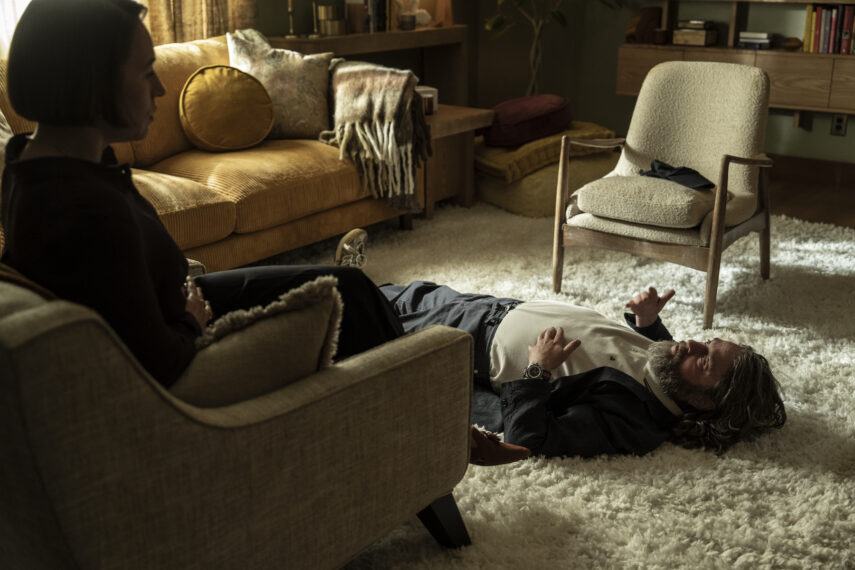
It’s a great question. I think that she probably started out early in her career with the best of intentions and a moral compass that was pointing in the right direction. And somewhere along the way, she’s really lost her way, and she is quite jaded. And I think they have all rubbed off on her. I think there also must have been something inside her that was drawn toward all of it. She didn’t land there by accident. And I think she’s slowly making these dangerous contracts with herself where she’s surrounded in this obscenely morally bankrupt world. And so she’s going, by comparison, my tiny little transgression surely is harmless or even justified. And so I think she’s walking down a slippery slope there, not walking, sliding, I suppose. And things are starting to snowball out of her control as she kind of gets more embroiled in the underbelly of that world.
Ed Araquel / AMC
Do you imagine that all of her clients are this high profile, or does she have other clients that balance out the craziness of the really rich guys?
I hope she has some balance. [Laughs.] Where’s this sort of just everyday marriage problems or childhood trauma?
Come on, give us some good childhood trauma.
Yeah, exactly. She probably had more of a balance, but I think she’s actively soliciting this type of client at this point for her own gains. And so yeah, I think she’s really surrounded by these, as she calls them, “billionaire man children,” for the most part.
Do you think Carl’s her favorite client?
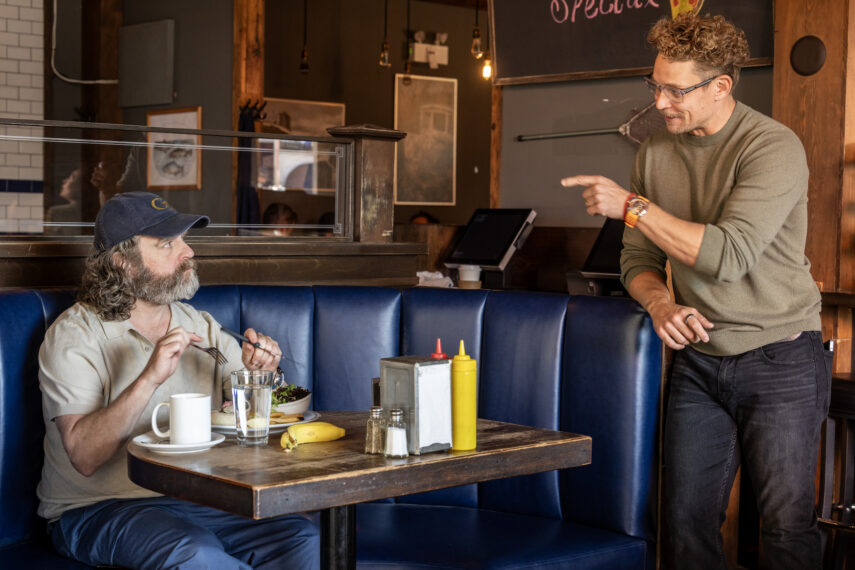
I do. Yeah, I do. I do. I think that she feels, of all of them, she could get through to him. I think that there’s something in Carl, there’s a shred of his humanity left, and I think that she thinks she can draw it out. Unfortunately, she’s in a place where she’s looking after number one, so she loses her way with him. But yeah, she’s got a fondness for him because I think she thinks she could make a difference versus some of her other clients who I think she thinks are hopeless, i.e., Duncan.
Ed Araquel / AMC
Even before the events of Season 1, was Duncan her least favorite client? He certainly is now.
I think probably, initially, she was maybe fascinated, and maybe she thought there was something to work with. By the time we meet them, she’s exhausted by him. And when he asks her at the very top of the show about their confidentiality agreement, Jonathan [Glatzer], Billy, and I had decided that he starts every session with the same question, and he’s asked her a million times about this confidentiality agreement. And I think that she sees him as someone who can’t absorb. And so if there’s no absorption, there’s no growth, and I think she’s exasperated, but she likes the paychecks, and also she’s using his information for her own gains.
That’s interesting that you guys decided that about the confidentiality thing. It adds a nice layer to [things they say to each other later this season].
Yeah. She really turns. She really takes all of the things that are his Achilles heels and stores up all her little breadcrumbs there and then really uses them against him when she’s cornered.
God. And therapists are the most equipped people to do that. It’s scary what they have on us.
She knows a lot. I dread to think if my therapist turned on me, what she might say.
That would probably be one of the most traumatic events of my life if that happened.
Totally. Luckily, I feel my therapist is a lot more talented at her job than JoAnne is.
So you are experienced with therapy. I wanted to know what research for this role looked like for you.
Well, mainly that. Honestly, I’ve been in therapy myself for seven or eight years, and I really found it totally changed my life. And again, I have a wonderful therapist, so it was hard to draw from her in any way to play JoAnne because they’re very different people. To be honest, as we’re meeting her in a stage of her career where she’s self-sabotaging and sort of abandoning her education and her better judgment, I didn’t do a wild amount of research. If anything, I should have researched more about the stock market because I was confused about some of that.
You mean Industry didn’t teach you?
No, I know [laughs]. You think I would have retained.
I don’t think anyone on Industry understands the stock market. It’s OK.
No, Industry, some of my lines, I honestly had to learn them phonetically, and I just thought, “Say them quickly, and you’ll sound like you know what you’re talking about.”
It’s about conviction.
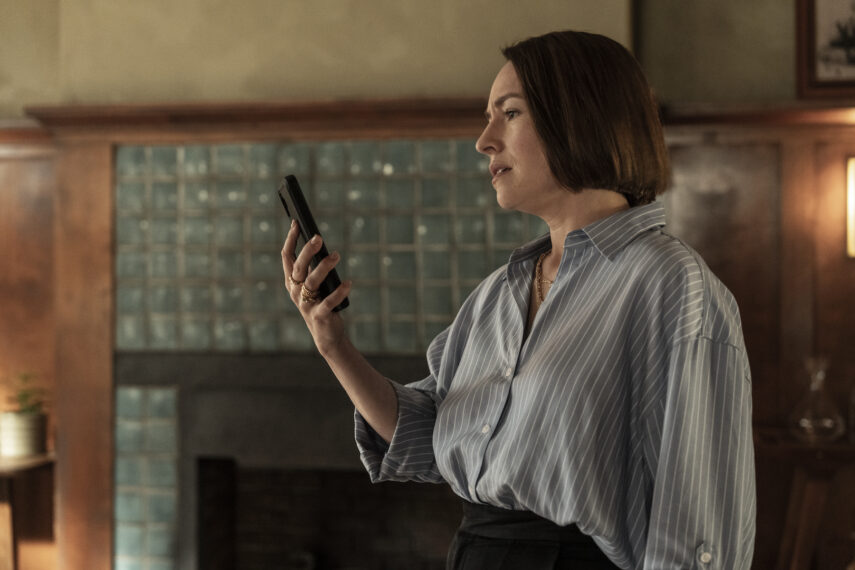
It’s about conviction. It’s the full follow-through. Yeah, I feel like [JoAnne] had all of these tools, but she’s kind of thrown them by the wayside in her job at this point.
Ed Araquel / AMC
This doesn’t seem like a show where things are going to go well in the season’s second half. Can you give a sense of how things really go off the rails?
Well, you have a whole host of characters who are all either on the precipice of abandoning their moral compass or already deep down that path. And so the comedy, the satire, the tragedy all come out of people making these terrible decisions.
Just to mention Orson [JoAnne’s son] and how talented Everett Blunk is, and how brilliant I think it was introducing the teenage characters into this world because they have a pure reflection of it and a purity that the more jaded adult characters don’t have. They’re the collateral damage, right? It’s like this so-called future that’s being built is supposedly for them, and yet the button everyone keeps hitting is self-destruct, which makes good television and hopefully isn’t a full mirror of what’s happening in our world right now, although the fact-fiction crossover is a little uncomfortable.
That segues well into my next question, which was that Barry was a show that critiqued its own industry. And while Audacity isn’t about Hollywood, the threat of AI and the powers that be are obviously very prevalent in Hollywood. Was critiquing AI and the data mining of it all part of the appeal of this series for you?

Kind of. I’m more interested in Jonathan’s bigger questions about humanity. He chose Silicon Valley as the snow globe to tell this story, and I think it’s a great choice because it’s such an extreme place, and it is the home of the so-called self-professed architects of the future. But I think he’s getting to something so much deeper about our core nature. And for these people, mostly men, to make the kind of money that they do off of these platforms, the behavior has to already be there. Don’t get me wrong. I hold many of them accountable for a lot, but what they’ve done, I feel, is they’ve taken the seeds of what’s already within us that’s unpleasant, and they found ways to manipulate and commodify it, but they didn’t invent the behavior. And I feel that Jonathan’s really getting to the root of that and the big questions about what makes us human, and how are we so far away from ourselves?
Within that, obviously, I’m very interested in what AI holds, and I’m glad that there’s a storyline that reflects that. I mean, I’m optimistic in that I don’t want to read an AI novel or your article or an article written by AI. I want to read your article. I don’t want to watch an AI film. I want to watch a human film. So I’m hoping you and I both have jobs in a few years.
Ha, me too.
Just before I got on this interview, I think I was on The New Yorker, and I was like, “Oh, maybe I’ll listen to this article instead of reading it,” because I was multitasking. It was like an AI voice, and I just didn’t want to listen to it. It just didn’t. I couldn’t connect to it, even though it’s not a bad rendition of human. It doesn’t feel human. My hope is that the desperate need we all have, a valid, desperate need to connect, I hope, will sustain. And television didn’t kill theatre, right? My hope is that AI won’t kill human-based art, and I promise to read and watch your interviews if you promise to watch The Audacity [laughs].
I promise I’ll watch the rest of the episodes and Season 2; you’re already renewed. I feel like the pendulum’s going to swing. AI is so undesired, I feel like on a mass scale, despite what the internet might say, that I feel the pendulum’s going to swing back into analog, and people are going to want physical media again. Maybe print magazines will make it come back. Who knows?
I will really cross all my fingers for that. Wouldn’t it be wonderful?
Bill Hader did a Barry screening in 2018 where he recalled one of your writers reacting to people finding your character, Sally, annoying. They said, “Barry kills people.” “Barry kills people” has gone triple platinum in my house. I use it as a response to so many things. My colleague and I, when people are being ridiculous about one person, we’re like, “Barry kills people.”
Barry kills people. It’s such a good line, and it’s so true and just shows how gendered we are, unfortunately, and how things are so stacked against women. Yeah, that was always an uphill climb. And I was always like, “You know what? Do not make her likable, make her relatable, make her human.” It’s not about being likable, it’s about her being someone that you know and something that you’ve seen in yourself. And so they held their promise to me. They didn’t dilute her and make her the moral compass of the show.
And I’m glad for that. Barry kills people.
Barry kills people.
The Audacity, Sundays, 9/8c, AMC, Streaming on AMC+





















Conversation
Please read the TV Insider Community Guidelines.
Register or sign in to join the conversation.
 Watchlist Easy access to only the shows you care about — all in one simple place
 Alerts Only important notifications — when a show is returning, when it becomes available to stream, and more.
 Special Offers Exclusive products we release related to your favorite shows and streaming services