
‘NCIS’: Wilmer Valderrama Unpacks Torres’ Major Decision & That Moment With Parker



Spoiler Alert
What To Know
- The latest NCIS episode reveals Torres’ dark past while undercover.
- Wilmer Valderrama breaks down that part of his character, relationships with Gibbs and Bishop, and major decision at the end.
Uh-oh, what’s Torres (Wilmer Valderrama) doing?! The latest NCIS episode ends with him making a decision that has us worried about him, especially considering the source of his new assignment. TV Insider spoke with Valderrama about that decision, a significant conversation with Parker (Gary Cole), and much more. Warning: Spoilers for NCIS Season 24 Episode 3 ahead!
Torres reunites with his handler, Keller (Mike O’Malley), from his undercover days prior to joining the team, and we learn just how far he went back then — he stabbed a person of interest’s hand, and as we learn in the present, he can no longer use his hand. But Keller thinks that Torres’ time with the team has made him weak and turned him into a house cat. He argues that Torres’ problem was never alcohol, but his addiction is to adrenaline, and he craves the danger he feels undercover. “Nick Torres is the cover,” he says. “Dante’s who you really are.”
Torres then admits to Parker that what bothered him about the horrible things he did in the past, justifying that it was in the line of duty, was how much he enjoyed it and that he felt alive. Parker brings up that he, too, has done some things in the past he’d rather forget, and Torres brings up the “recent past,” obviously referring to Parker teaming up with Gibbs (Mark Harmon) to avenge Vance’s (Rocky Carroll) death.
The episode ends with Torres accepting Keller’s offer of side jobs with the CIA.
“I really wanted it to be so different and good for the show, and we had such great conversations and collaborations to like, ‘How do you level up on Episode 3?’ And I just love that my character can go to all these worlds and these destinations that can just give us a little bit more of a ride. And how great was Mike O’Malley?” Wilmer Valderrama tells us. Below, he breaks down the major Torres episode and teases what’s ahead.
This is a dark episode for Torres. So how does he feel about his team knowing just how far he went when he was undercover?
Wilmer Valderrama: We had these conversations. We really were thinking about how, every couple of years, we shift the paradigm of all the characters and how they intertwine with each other so it doesn’t become too routine. And a lot of the paradigm shifting in these characters comes from their real lives: Where they came from? What was their childhood like? And all these things kind of inform the audience and all the different character traits that eventually wake up, whether it is within a case or within a friendship. So with this, Torres’ past has always been such a mystery.
We knew that he was an undercover guy, but we didn’t know the lengths and how far he had had to go at some point to get the job done. And what toll did it take, and what taught him, and what shifted and what changed in him?
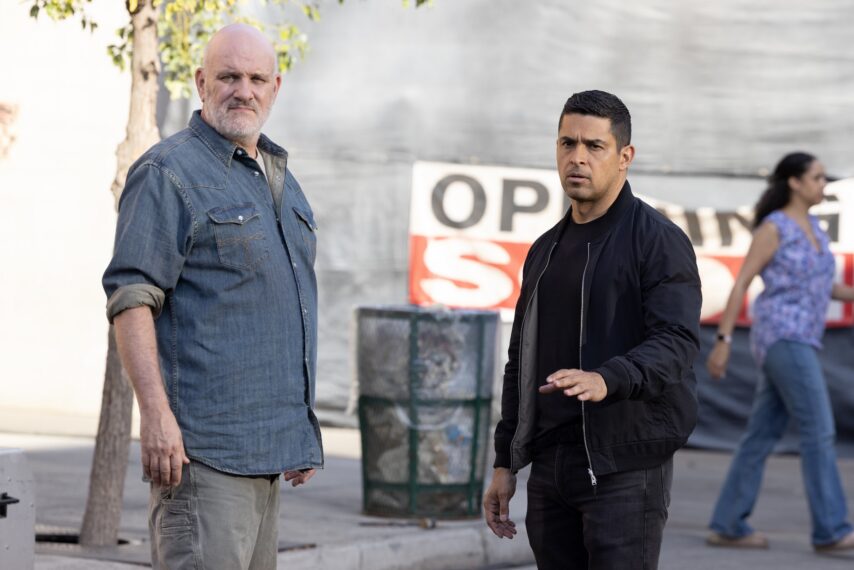
Sonja Flemming/CBS
And I think as he joined the X-Men, as I call him, when he joined the team, he had to relearn a new set of morality and valued skills that actually allowed him to trust the people around him. So I think that for his team, for 10 years, they’ve been side by side with an agent who has gone the distance, who has put his life on the line for them, and as they have for him, too. And to understand what he’s capable of, to understand how far he can go to get the bad guy, I think has been really interesting. So there’s a couple of scenes in this episode where you really see that reaction, where you see their reality shifting right in front of Torres. And it’s fascinating to see what they cannot unsee for the rest of the show and specifically for the rest of their friendship with Torres. What does this do to their friendship? How does this alter their common commute of not just workflow and the job that has to get done, but how does it really shift how they see one another?
Torres admits to Parker that what bothered him after was how much he enjoyed it, how he felt alive. Why does he tell Parker why not his partner? Does he not want Knight to see that part of himself?
Yeah, so two things. I think Torres has been in the know for some of the most iconic things that have happened with Parker, and he’s been from a distance, and I think there’s something that eventually will reveal later in the season. Torres very much understood what Parker had to do in some instances, and if you know what I’m talking about, I’m talking specifically Leon Van’s departure, and what really happened there.
Gibbs sniping the guy.
Yeah. So how much did anybody really know? I’ll tell you that most of the team could only assume, but Parker really knows the truth. And in this episode, we flirt with the idea that both Torres and Parker were in the know, or at the very least Torres was onto Parker and figured it out. And the code of honor for two individuals who both have a very kindred spirit when it comes to just breaking the rules and just getting it done is what brings them together in this instance.
I think that he’s been pretty coy and vague when it comes to either Tim or Knight. These are two like a brother and a sister that perhaps he, kind of like any other family, wouldn’t want to change the perspective or dynamic because I think selfishly, Torres needs that dynamic to stay the same in order for him to be not just stable, but to be happy where he’s at and to be accepted for whatever mirage he’s created for himself. And I think that’s an interesting kind of balance between all the characters. And I think the Parker one felt like, it would’ve been Gibbs if he was there. But with Parker, they share a very interesting parallel road where they both have had to do what it takes to actually have justice prevail. And I think that’s what brought them together in this episode.
At the end, Torres goes to Keller about that side job with the CIA, and it seems like Keller’s “Nick Torres is the cover, Dante’s who you really are” really got to Torres. So why does he think that the person he used to be is who he is, and he needs to take this CIA job?
I think he’s not quite convinced, but I think he’s going to figure it out. He’s going to want to find out. And I think in order to find out, he has to throw himself in the deep end again. He can’t just psychologically make a decision. And if we know anything about Torres is that he’s going to step on it. He’s just going to throw himself in the deep end and swim it out and figure out [if he] can he survive it? And in every task force and in every team, you need a guy who is willing to go farther than anyone else. And I think this is a great and interesting and exciting setup for things to come for Torres. But I think that Torres, when you really think about the makeup of Torres, and you think about his blueprint, he was built, taught, and trained to [be in] some pretty extraordinary, terrifying situations for anyone who could just be a homicide detective.
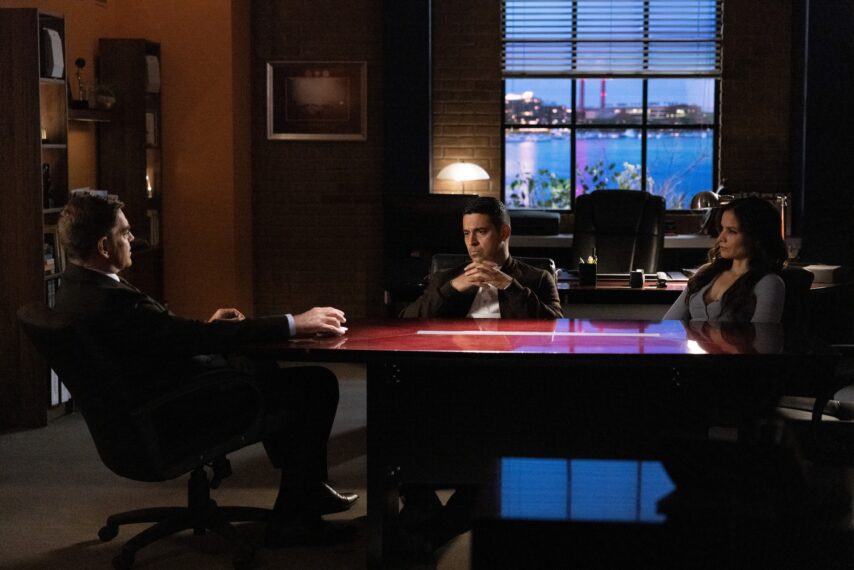
Sonja Flemming/CBS
And that’s in him. There is a button, there is a trigger that, when ignited by his superiors, he turns into that wolf. He turns into that lone wolf, and he is willing to go where most just won’t. And I think that’s something that Torres has been craving: Going back into what he’s really good at, going back to get bad guys that most can’t. And I think that’s what’s probably teasing here, that these CIA jobs or these side jobs are going to teach Torres which version of himself is he the happiest in? Is it just complacent, being in the team and just doing what he’s told? Or is it being in the field and just making decisions by instinct and by presentation, whatever reaction he has to create with whatever case he gets confronted with?
So I think the idea is that this is him discovering: Is he a little bit country? Is he a little bit of rock? Is he a little bit of hip hop? And is he also country? And I think this is kind of the journey that he’s embarking in. But what I will tell you is that whatever he finds out, he’s going to settle into probably the funnest version of Torres, someone that’s going to be very dynamic and continue to actually experience joy in the job again because that dangerous feeling, that adrenaline, is going to probably be back in his life.
What can you say about what we’re going to see when it comes to these CIA jobs? And is he telling anyone about this? Anyone on the team? Does his director know?
So I think the director is going to be in the know. I think that the director is going to also allow it to happen at some point, but we’ll see how it all turns out that way, because I think there’s a lot to be told about how DiNozzo feels about where Torres is. And at the end of this episode, as you can see, DiNozzo’s like, “Can I use this guy or should I be concerned about this guy?” And for the audience, they know. They just met. So DiNozzo doesn’t really truly know who Torres is. He’s heard the legend; he’s heard the stories, but this is the first time where he’s about to really find out what Torres is really capable of and how he can be essential to DiNozzo’s agenda for the team. So I think it’s going to open the door for a more dynamic relationship between them both and understanding that they both also are kindred spirits and they both understand what needs to be done when it comes to going against the worst. So I think that part of it I think is going to be really cool.
So in many ways, I think some will be in the know, and I think most won’t, which will create an interesting parallel universe for Torres and his team that who knows, how it actually will inflict self-wounds or if it’ll inflict some type of new dilemma. But I think it’s going to bring them together in different ways, but it also is going to create — I don’t know, it’s a very complicated thing to phrase because we’re really having a lot of fun with it. I think that what it’s going to do is going to pull a thread on the reality they live now and it’s going to create a different rhythm.
And that’s what we’re after. What we’re trying to do is we’re trying to pull threads and shake it up a little bit and then have our agents have new realities to deal with so the show feels not only new again, but exciting for the fans. And I think that what Torres is doing is kind of essential to rumble it up a little bit. But I think to your point, to be going straight to the point, I think DiNozzo is clocking it. I think Parker is onto Torres and we’ll see what the CIA jobs are going to turn into.
You said that Torres would’ve talked to Gibbs, and I do have to wonder, because we know what Gibbs means to Torres, and around this time, actually, Gibbs is in DC visiting Tony on Origins in the timeline. But do you think Torres needed to talk to Gibbs about all this? And do you think that Gibbs could have gotten through to Torres in a way that no one around him can right now?
Yeah, I think so. I mean, I think that Torres has respected Gibbs’ departure. He had a tough time coming in terms with that. He had a tough time coming in terms with the fact that Gibbs had taken his time back. And he felt a little abandoned; he felt a little betrayed there, but he truly just had to realize that some people move on. And as he comes in terms with that, I think this is one of those moments where only Gibbs would’ve really understood what the right path would’ve been, knowing that he himself has made those decisions in the history of the show. And I think a lot of this comes from him learning the value and the integrity of how Gibbs had carried himself as a leader. And Torres also wonders, “Can I ever be [a leader like] Gibbs was? Can I teach myself to go the distance for, with, and by my team? And what are those times where I have to go rogue?” which he has himself.

So this could have been an essential time where they were connected. And look, I won’t say they connected or not connected, but there’s a lot of story to be told when it comes to this entire situation. And Gibbs has always been a major influence on Torres because Torres never really have a real father and him becoming such a great morality bar that was set forth for Torres to follow.
Would Torres have opened up to Bishop, and do you think they’re in contact?
I think that Bishop is where Torres was 13 years ago. I think Torres, a part of him wonders what it would’ve been like — and if you remember from the episode called “Her,” where Bishop comes back and she’s in trouble and throws Torres for a loop and has some type of closure there, I think Torres was presented with an interesting opportunity there and he chose his current team for now. And I think he absolutely would’ve connected with Bishop; I would say 100%. I mean, they connected on a different level when she resurfaced back on the NCIS world last year, and I think they found that they’re more alike than they weren’t before. So I think that Bishop is not very far from where Torres is, if you ask me. If the writers have other ideas, we would have to debate that one. But for me, the strongest lifeline for Torres would probably be Bishop.
You did bring up Torres and Parker alluding to the Gibbs and Parker avenging Vance of it. When Torres brought that up, was that a low blow, do you think? Was he deflecting and trying to get Parker off of his case?
I think Torres — I’m so happy you asked that question because when we were shooting those scenes, Gary Cole and I had extensive conversations about where we both stand here. And I think that the approach we took was one of Parker is looking at Torres going into a pond that might be too deep for him, and Torres is reminding him, reminding Parker that, “I can take your advice, but let’s face it, we’re both in a similar situation.” But yeah, that’s fascinating. I’m trying to think a little bit about it, because we opened the door for it. I don’t know. What do you think? What is your perspective?
I think he’s deflecting because if he turns it back on Parker and on what Parker did, it’s like, “See what you did. You can’t really call me out on what I did.”
Yeah. I mean, we talked about that, and I think we played it because we went for it. And I think the idea was to say, Torres was like, “Hey, before you go into too judgy or too teacher-student thing here, let’s not get it twisted. I’m not trying to take advice from you.” It’s an interesting thing, but I think he is deflecting because I think there’s something more about Torres we’ve yet to actually know about. And I’m telling you that as kind of a big spoiler, but Torres is deflecting because he needs the voice of reason, and that’s why he’s reaching out to Parker, but he’s not being completely honest with Parker on what he’s possibly handling right now or what he’s possibly getting into right now. And I think Parker is going to find out at some point.
NCIS, Tuesdays, 8/7c, CBS

Grab Your News!
Get absolutely everything about NCIS in your inbox!















Conversation
Please read the TV Insider Community Guidelines.
Register or sign in to join the conversation.
 Watchlist Easy access to only the shows you care about — all in one simple place
 Alerts Only important notifications — when a show is returning, when it becomes available to stream, and more.
 Special Offers Exclusive products we release related to your favorite shows and streaming services