
‘Star Trek: Strange New Worlds’ Director on La’an Being ‘Seduced by Her Dark Side’




Spoiler Alert
What To Know
- Director Axelle Carolyn transformed a familiar Star Trek setting into a haunted-house atmosphere for “The Griffin Incident.”
- The episode required Spock to embrace his human side and display fear.
- She talks about working with Flanagan and his new series, Carrie.
Star Trek: Strange New Worlds boldly goes where the franchise rarely ventures: straight into a full-blown ghost story.
In Season 4, Episode 2, “The Griffin Incident,” La’an Noonien-Singh (Christina Chong), Spock (Ethan Peck), and James T. Kirk (Paul Wesley) answer a mysterious distress signal coming from the Griffin, a Federation starship that vanished without a trace nine years earlier.
Once aboard, the trio discovers a seemingly pristine but completely abandoned ship. There are no crew, no escape pods, and no explanation for what happened. But the deeper they venture into the Griffin, the stranger and more terrifying things become. Bloody body bags mysteriously appear, ghostly figures stalk the corridors, and each officer begins experiencing disturbing visions that prey upon their deepest fears and vulnerabilities.
What begins as a Starfleet mystery quickly becomes something closer to a haunted-house movie in space, as the Griffin turns the crew against themselves and forces them to question what is real, what is lurking aboard the ship, and whether they can trust their own minds.
Bringing that unusually dark corner of the Star Trek universe to life was director Axelle Carolyn, who leaned into the language of horror to turn the familiar halls of a Federation starship into something genuinely terrifying. TV Insider spoke to the director about her ability to transform the usually warm and welcoming world of Star Trek into a haunted house, pushing Spock and La’an into some of their darkest territory yet, the classic horror films that inspired the episode, and what she learned from working with Mike Flanagan on the upcoming Carrie series. Warning: Spoilers ahead for Season 4 Episode 2 of Star Trek: Strange New Worlds!
This episode essentially turns a Federation starship into a haunted house. What was the biggest challenge in transforming such a familiar Star Trek environment into something genuinely terrifying?
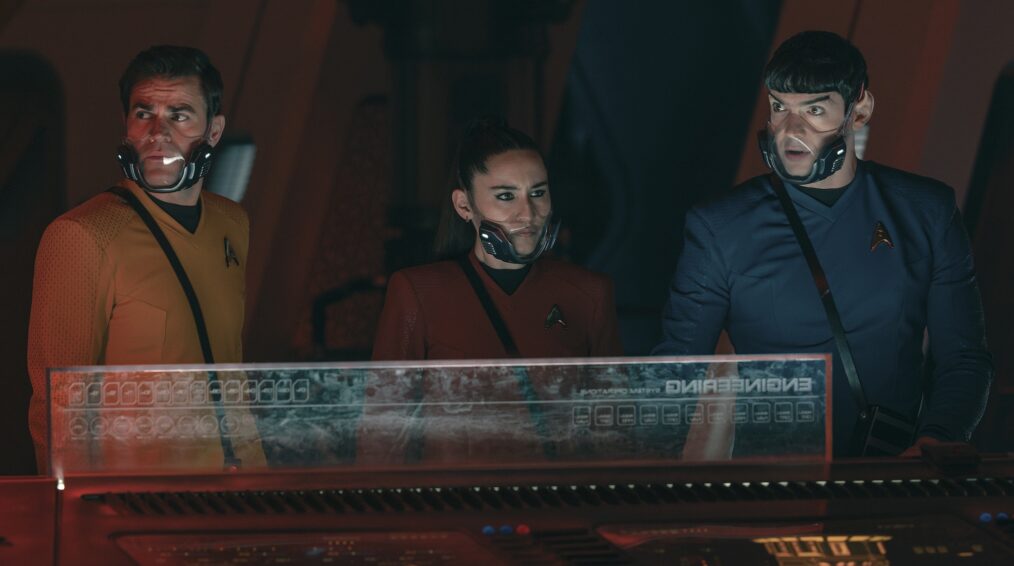
Axelle Carolyn: On Strange New Worlds, and I think in Star Trek in general, when it comes to the Enterprise, they go to great lengths to make sure that the Enterprise feels like home, that space is not cold; that space is a place where you can go back and you feel surrounded by people you love. And so the lighting is going to be warm, the sets are designed to be cheerful, and although we’re on a different ship, we’re on the Griffin, we had to use the Enterprise sets, obviously, because it’s the Federation, it’s the same kind of ship. And the walls are completely white.
That was one of the main challenges. If you want to walk through the hallways and make the hallways very dark, you have to make sure you don’t shine any light at the walls; otherwise, they just reflect the light and become incredibly bright. And so it’s turning an environment that’s built for warmth and for a homey feeling into something disquieting and that’s dark and that feels like something you would not feel comfortable in, and that inspires scares. So, we did a lot of work with the DP Glenn Keenan to rethink the lighting for everything.
Then it was deciding on the color scheme. Are we going towards blue or are we going towards white? We came up with a kind of lighting that we call the “Griffin Green.” It’s kind of white, but with a little green tinge to it. And that goes throughout the ship and gives an atmosphere that’s a little bit more disquieting.
Jan Thijs/Paramount+
“The Griffin Incident” immediately evokes films like Event Horizon and Aliens to mind. Were these influences part of your vision, or did you pull from elsewhere?
Event Horizon was obviously a big one, and I had a couple of little homages.
I think that was a big inspiration when they were writing it, but in the way that we filmed it, my inspirations were mostly classic ghost stories. I’m obsessed with 1963’s The Haunting, so I always pull shots from that. I’m obsessed with, and I love, the aesthetic in general, and things like The Innocence, so we used a lot of wide-angle lenses, which is something that those ghost stories do really well.
I had a couple of shots for which I referenced The Haunting of Hill House, the Mike Flanagan adaptation, and The Devil’s Backbone was influential for the look of the ghosts. I pulled from a lot of classic ghosts, I think.
Was there something specific in your past work that made them think you were the right person to bring in for this episode, or was it simply a project you were excited to take on?
I don’t know if it was something specifically, like a specific project that I’d worked on, but I know that Chris Fisher, who’s the producing director, is a phenomenal ally and champion throughout the season for all the directors. He’s the one who put my name forward. He went through my work, and my Instagram at the time was full of the fact that I love horror. He knew that I live and breathe that genre, and he was really looking for someone who had that passion and had that knowledge of the genre.
The way that Strange New Worlds works is that every episode is a different type of story, so they find directors who come in and direct them like movies. So they kind of give you that material, and they say, “Here it is, treat it like a feature, you can make it yours. We know that this is up your alley, so do your thing.” And they really mean it.
Ethan Peck has to portray Spock slowly unraveling while still maintaining traces of Vulcan logic. How did you work together to find that balance?
I think Ethan knows his character so well by now. He’s on Season 4, and he’s not playing Leonard Nimoy, you know? He kind of knows the Spock he’s playing inside out. He’s just very smart at kind of keeping a Vulcan side throughout everything that he does. But what was really interesting for him with this script is that the writer, Robbie Thompson, built an arc for Spock through the episode where Spock, when we find him, is a little bit more leaning towards his human side. He’s in a relationship with a human. He’s a little bit more open with the crew.
And this episode is his way back towards logic. So we push him towards the extremes of human emotions, where he’s gonna be really scared, he’s gonna be reacting in a big way, and then he finds logic, and it guides him back. Because he’s going back towards the Vulcan side later on, it allowed him to have a little bit more freedom to explore that human side, which was really necessary for a horror, because if he doesn’t look scared, the audience is not going to be scared either. So, we knew that he had to show that he was not comfortable on a Griffin, for sure.
Spock’s self-inflicted injuries are some of the most disturbing moments in the episode. How did you approach filming those scenes without crossing into gratuitous horror?
I like that you’re saying that we didn’t cross over. That’s good.
I wasn’t too concerned about that because, again, I think that every scare is based in something psychological and specifically tied to that character. So, even if we go a little bit far with it, it is still something that makes sense emotionally within the world of Star Trek. And I think for that specific moment, which was like destroying an icon, isn’t it? It’s so fun to get to do that.
Christina Chong’s La’an carries much of the emotional weight in the episode as she loses her grip on reality. How was working with her? What impressed you about her performance?
I love Chrissy. I think she’s incredibly talented. And the part that I like the most is when she turns completely at the end. And I thought it was such a brave performance because it’s such a weird kind of turn, and it’s everything that her character fears and has been established through. So, it’s a continuity with what we’ve seen in the past few seasons, where she’s so scared of the dark side of her character, and she really gets to express it completely in this one. Like, that’s kind of her worst-case scenario. So, it was that the scares are built in something that emotionally is already resonant with her.
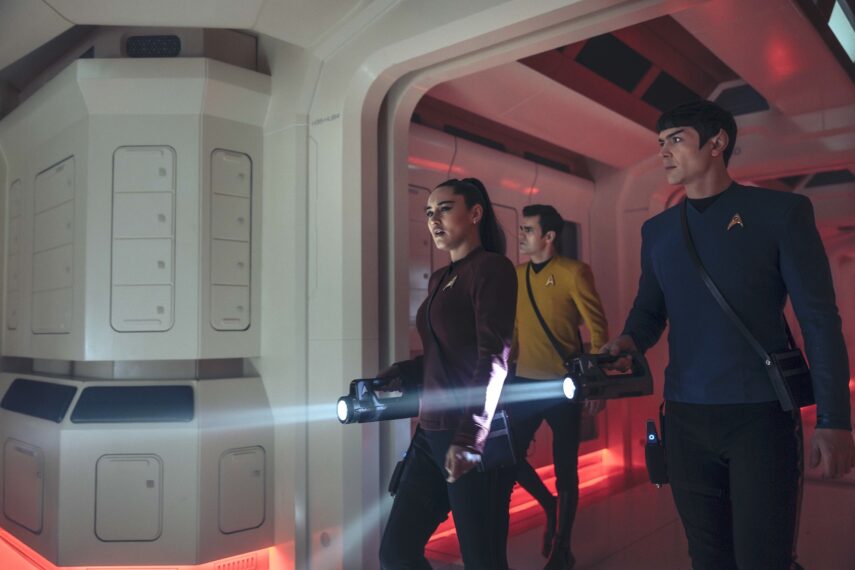
Photo Credit: Jan Thijs/Paramount+
And that’s one of the things that I love about the way that this episode is built, is that every character goes through something that says something about their personality, their personal fears, where they’re at in their lives, and that’s what the Griffin seems to exploit. And so in her case, she goes from being this person who’s very in control and very in charge to just becoming an officer of the Griffin.

She really has this arc where she’s in control, and then she kind of loses it, and she’s trying to hang on to reality, and then she is seduced by her dark side and embraces it fully. And it was really fun to see her do that, and the way that she’s portraying it, she doesn’t just go, like, “Oh, I’m gonna be villainous, and I’m gonna have a dark voice.” She makes it almost friendly and happy and like, “I’m in my true place! Don’t you see? This is where I’m supposed to be!” And I thought that was so much more powerful, and I love when she’s talking to Kirk towards the end.
Now that you’ve become something of a recurring collaborator in the Mike Flanagan universe, what aspect of the new Carrie surprised you most once you got behind the camera, without giving away any spoilers?
I would say the tone. Mike had a very clear vision for what the tone of the show would be. And I’m not gonna say anything about what this tone is, but I think that that’s both what surprised me and delighted me the most. He showed us his cut of the first episode before I started shooting mine — Mine is Episode 4 — and so that was a fantastic way of communicating what he was going for, the kind of music he was going for, the kind of emotions he was trying to convey. I think that that is something that probably will surprise people, and that I can’t say much more about.
You’ve become something of a recurring collaborator for Mike Flanagan. What have you learned from working with him across multiple projects?
Mike is hugely organized throughout the whole process, but particularly in prep. When I made my first episode with him, The Haunting of Bly Manor, I had not done TV before. I had no idea. But I’d just done a couple of features.
And I was so impressed by the amount of detail that he gets into in pre-production, working with his DP, knowing exactly where he’s going. I did Bly Manor with him, and I prepped it the way that I usually would prep. But I also had a glimpse at how he was working, and he was prepping Midnight Mass at the time.
And then when we did Carrie, he wanted us to try to work a little closer to the way that he usually works. So, we got to adopt a few of the methods that he applies in prep and the kind of software that he uses, and I thought it was incredibly useful.
But the other thing that I love about working with Mike, and that was, I think, probably why we got on very well from the beginning, is that his emphasis — despite the fact that everything he does is very scare-oriented — is that he is interested in the characters first. And I think that’s why he thrives so much in TV, but he is very much … everything is grounded in the emotions of those characters. And he’s interested in scaring you, but he’s also interested in making you cry and making you feel a whole lot of different emotions, and I think that that is the fullest experience you can have when you’re watching horror.
That’s definitely something that I’m taking away from working with him, is that emphasis on what is the human emotion that people will be able to connect with, besides just, I’m gonna scare you s**tless.
Star Trek: Strange New Worlds, Thursdays, Paramount+
Where No One Has Gone Before
Get absolutely everything about Star Trek: Strange New Worlds in your inbox!









Conversation
Please read the TV Insider Community Guidelines.
Register or sign in to join the conversation.
 Watchlist Easy access to only the shows you care about — all in one simple place
 Alerts Only important notifications — when a show is returning, when it becomes available to stream, and more.
 Special Offers Exclusive products we release related to your favorite shows and streaming services