
‘It’s a Wonderful Life’ Is Still the Best Holiday TV Event


Everyone has their own holiday traditions when it comes to television, whether it’s an annual viewing of Elf or an animated favorite like A Charlie Brown Christmas, but one remains quintessential and that’s Frank Capra‘s black-and-white classic It’s a Wonderful Life.
Not originally made as a holiday film, It’s a Wonderful Life wasn’t initially considered a box office success, but it went on to become a holiday classic and TV tradition. Focusing on the story of George Bailey (James Stewart), the film chronicles his life from childhood to a pivotal point in time where he’s poised to lose everything.
On the brink of committing suicide to try and salvage his family’s name, legacy, and money, things are dire for the building and loan banker on Christmas Eve. As prayers abound for his safety, angel Clarence (Henry Travers), who has yet to earn his wings, is sent to help George in his hour of need.
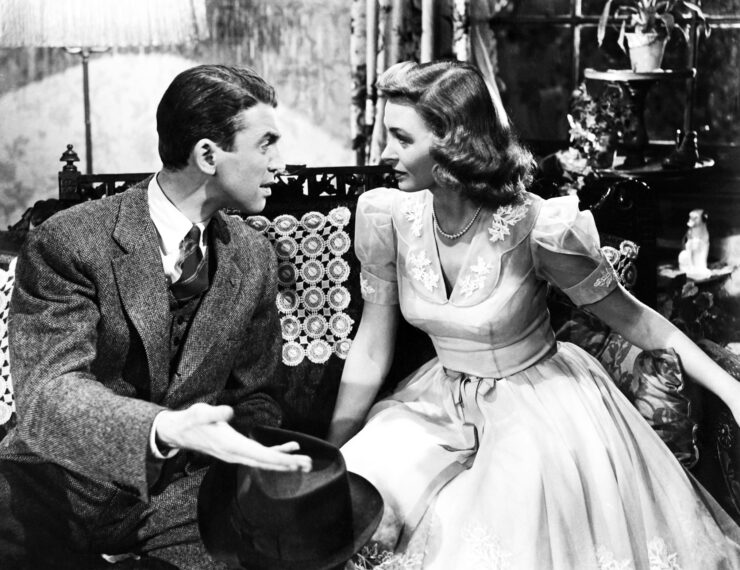
(Credit: Everett Collection)
It’s a concept that may not work as well in a film today, but a story filled with plenty of simple and human themes relatable across the board regardless of religion or background. At its core, the film is about a man who has time and again sacrificed his own wants and desires, whether it’s travel, schooling, or career, to help those around him, and even when he finds himself in hot water, he considers his family’s future at the cost of his own life.
But why should we care? Following George through his life, including his romance with his wife Mary (Donna Reed) helps build emotional stakes. We see his bond with his brother Harry (Todd Karns), who would have died had George not saved him after falling through thin ice as a child. And then there’s the love for his community, friends, and children which is palpable through his actions and desperate need to protect it all.
When money is misplaced by his forgetful uncle Billy (Thomas Mitchell) and snagged by nemesis Mr. Potter (Lionel Barrymore), George is transformed for the worst and finds himself ready to jump from a bridge on the outskirts of his town Bedford Falls. It’s Clarence who helps show George all the ways everyone’s lives would be different without him that he begins to understand his own value.

Ultimately, George’s struggles are resolved when his community realizes the pickle he’s found himself in, and that the kindness and care he’s shown for decades ripples in the form of their financial help. In a world where we’re often faced with hopeless scenarios, it’s films like It’s a Wonderful Life that remind us of what’s important.
While other holiday TV shows and films may be just as nostalgic for viewers, none really drive a message home quite like this movie. Without fail, every holiday season, whenever I hear Harry Bailey toast his brother, George, “the richest man in town,” I can’t help but shed a tear because of its double meaning. The money is one thing, but in that sequence, George Bailey is emotionally rich, and isn’t that what we’re all striving for at the end of the day? After all, as Clarence’s note to George reads in the movie’s closing scene, “Remember, no man is a failure who has friends.”
It’s an emotionally satisfying conclusion to a nearly three-hour network viewing experience during the holiday season. And like any good book or film, each viewing experience is just marginally different from year to year as we all change with time. Needless to say, It’s a Wonderful Life is must-see TV still, almost eighty years after its debut.


James Stewart

Donna Reed

Lionel Barrymore

Thomas Mitchell

Henry Travers

Beulah Bondi

Frank Faylen

Ward Bond

Gloria Grahame

H.B. Warner

Frank Albertson
Todd Karns
Samuel S. Hinds

Sheldon Leonard

Ellen Corby

Virginia Patton
Mary Treen
Charles Williams
Sarah Edwards
William Edmunds
Argentina Brunetti
Lillian Randolph
Bobbie Anderson
Ronnie Ralph
Jean Gale
Jeanine Ann Roose
Frank Hagney
Carol Coomes

Karolyn Grimes

Larry Simms
⨁Full Cast & CrewWhere to Stream


















Latest Headlines
- Helen Mirren in ‘Goodbye June,’ ‘Pluribus’ Finale, ‘It’s a Wonderful Life’ and More Christmas Classics, a Faked Funeral at ‘Palm Royale’
- How to Stream ‘Elf,’ ‘Polar Express’ & the Other Top Christmas Movies in 2025
- Best Classic Movies on TV This Christmas Eve & Christmas
Conversation3 Comments
Please read the TV Insider Community Guidelines.
Comments are closed on this story.
-
G
Right up there withj White Christmas, the music in WC makes it a tie for me.
1
-
O
I finally took the chance on this film with my mother at the end of 2020, specifically the three-hour cut on NBC. I agree with the consensus that it's an essential message everyone ought to take heed of, and more than deserves its place near the heart of the Christmas media canon. It's just too bad that it spends so long wallowing in depression and cynicism for most of the runtime. Making it through that just once was a test of my resolve, and now that I've seen it, I never want to watch it in full again.
If anything, the experience made me admire all of the TV parodies that have been made over the years. The SNL sketch where the ending is changed is a personal favorite. Instead of welcoming Mr. Potter with open arms, the gathered townsfolk beat the stuffing out of him for giving them so much grief. Hilarious catharsis for those of us not feeling especially charitable at that point in the film.
The Rugrats episode "Chuckie's Wonderful Life" has nothing to do with Christmas, but does a great job taking the film's major plot beats and translating them to a kid viewer's anxieties. The red-headed geek and his similar-looking guardian angel look at life in the show's universe without Mr. Finster around to be the voice of reason. As you can imagine, the main cast is much worse off: Phil and Lil argue over the pettiest of toy acquisitions; Angelica is a domineering, grossly overweight queen gorging on cookies from her sagging throne; more in my reply.
-
O
Tommy, lacking his usual boundless confidence, is powerless to prevent his bossy cousin from swiping his rattle and insulting his character at every turn; and all the parents, never exactly effective in that role in regular continuity, are even more so here, mere ants for Angelica to manipulate to her every whim like everyone else. Not to mention the neighborhood in general is run-down and seedy as heck, very much the stepchild to Biff's alternate 1985 in "Back to the Future Part II." Seeing his loved ones so downtrodden renews our hero's spirit, and when he wakes up from this nightmare to find life "back to Norman," he vows to always support his friends and stand up to bullies like Angelica (which, given the show's nature, never actually happens onscreen, but I'd like to think Chuckie can stand on his own two sneaker-clad feet a bit more after this).
One of the show's standout episodes, easily in my top five of the classic first 65, and at only 11 minutes long, it's a breeze to consume. It's worth a look on Paramount Plus, or at least watch Youtuber DuskTillShawn's fantastic analysis of its larger themes.
-