
‘Antiques Roadshow’s Nick Dawes Details Saga of Estimate He Got Wrong



What To Know
- Antiques Roadshow appraiser Nick Dawes admitted he overestimated two Colonial American pitchers.
- Experts later poked holes in Dawes’ theory of the items’ origin.
- Dawes, however, ended up having the last laugh when the items sold at auction.
The Antiques Roadshow appraisers may have years of knowledge and expertise, but it isn’t always easy to accurately estimate an item while filming the hit PBS show.
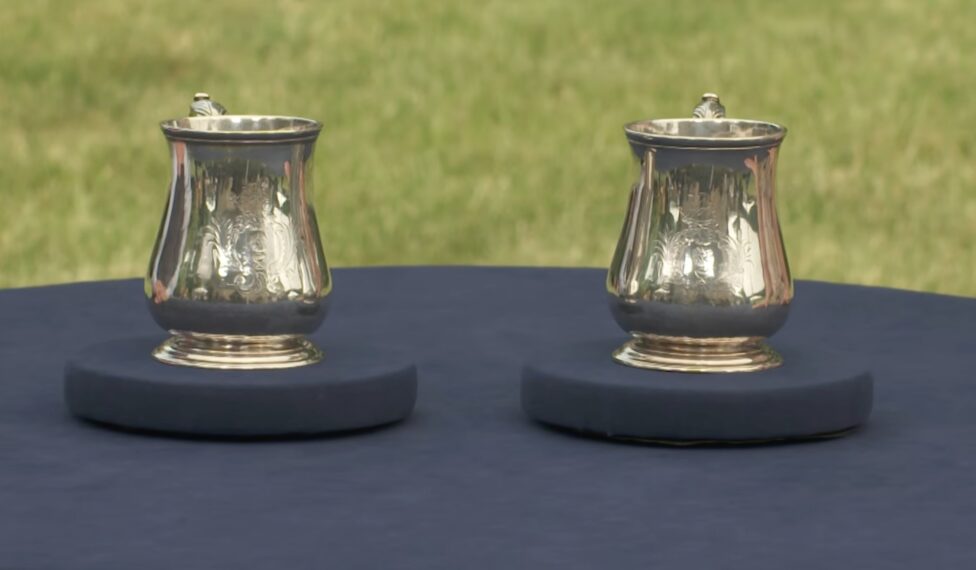
Nick Dawes, one of the show’s appraisers, who works at Heritage Auctions, opened up on a recent episode of the Antiques Roadshow Detours podcast about a specific item he overestimated. “I’d never seen anything like that at Roadshow,” Dawes said, per Entertainment Weekly, referring to a pair of Colonial American pitchers (called canns).
“It looks like a tankard, beautifully engraved, the kind of thing that collectors dream about,” the international antiques dealer explained. Yet the excitement got the better of him, and under the time constraints of taping, he had to make a snap judgment on the canns’ value.
“I looked very carefully at the armorials, and the sailing vessel on one of them was flying the British flag, but the other one was not,” Dawes recalled. “It was flying flags that were simple horizontal stripes. And I wondered about this, and I didn’t have a lot of time to think about it. This was happening more or less as we were taping it.”
Antiques Roadshow PBS YouTube
After consulting a colleague, Dawes guessed the marking was a flag representing the Sons of Liberty, a Colonial political group that protested British rule. With that in mind, he dated the canns back to around 1776, “in the dawn of American independence, or you might say, in the twilight of British colonial rule.” He valued them at between $10,000 and $15,000.

However, Dawes confessed that his valuation was off. Three Revolutionary War experts later identified the markings as the Vassal family crest and likely belonged to the wealthy Loyalist family. This poked a hole in Dawes’ Sons of Liberty theory and dated the canns to about 20 years earlier, around 1759.
The vessels returned to Dawes’ auction house, and another appraiser dated them to 1745, listing them at $3,000 and $5,000. Dawes, who has over 35 years of experience in antiques, maintains the canns were created around the 1760s.
Despite this miscalculation, the canns attracted strong demand, especially as the U.S. celebrated its 250th anniversary. In the end, Dawes’ initial prediction came true, as the items sold for $10,000. “So my original estimation was on the money,” he quipped.
Antiques Roadshow, Mondays, 8/7 c, PBS








Conversation
Please read the TV Insider Community Guidelines.
Register or sign in to join the conversation.