
3 Ways to Hear Dialogue Better on TV




Do you have a hard time hearing characters over big action sequences like in Stranger Things? Are closed captions your go-to fix? There might be another option.
Below, we’re breaking down a few ways you can improve the intake of dialogue on TV ranging from adjusting your settings to using headphones.
Adjust Your Settings
TVs have differing audio setups and often use fancy (read: confusing) terminology. To begin, press Menu on your remote control and select Sound. Here, you will find the settings that may need to be adjusted. This could require some trial and error. First look for something called “Dynamic Range Compression” (some TVs have an option called “Night Mode,” which is similar).
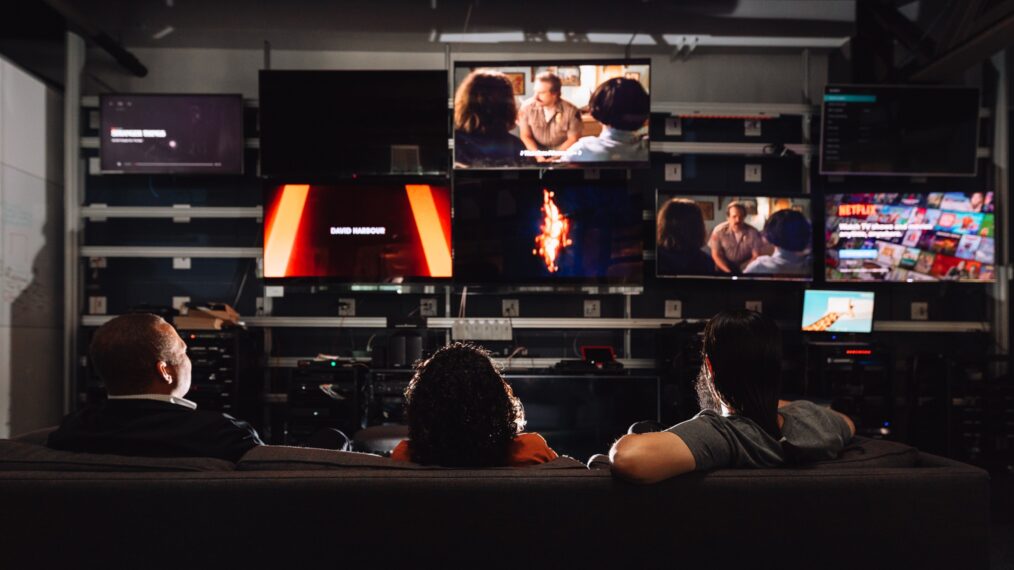
(Credit: Netflix)
The idea of this setting is to even out (or compress) loud noises like explosions and softer ones like dialogue. By bringing them closer together in volume, you will be able to hear words better. If that fixes the problem, great! If not, it’s back to the Sound menu. Adjust the EQ (short for “equalization”) settings: Try going lower on the bass and higher on the treble.
Try Headphones
Wireless headphones can be perfect for TV watchers, especially those that come with their own Bluetooth transmitters, such as HSPRO’s Wireless TV Headphones ($65, Amazon) and Insignia’s RF Wireless Headphones ($50, Best Buy). You don’t even need Bluetooth on your TV, since these work by plugging the transmitter into your TV’s audio output jacks.

Get a Soundbar
Flat TVs have less room for speakers, which are often located in the back. Soundbars are external speakers that can offset both of those issues. The ZVOX Dialogue Clarifying AV157 Sound Bar ($149, Amazon) comes with its AccuVoice technology plus 12 “voice boost” settings, and the Bose TV Speaker Bluetooth Soundbar ($230, Best Buy) offers a dialogue mode right on the remote control. Look for a soundbar that has a speech-enhancement feature—which hopefully will sound like music to your ears.
Conversation9 Comments
Please read the TV Insider Community Guidelines.
Comments are closed on this story.
-
B
The soundtracks of many shows need to reverse the voice and background music settings. The dialogue is more important than the music, so the voice recording settings should be louder than the background music settings.
30
-
C
Thank you, Captain Obvious
10
-
-
R
No matter how much I vary the settings, NCIS and Hallmark movies are still obnoxiously overwhelmed with background music. This is bad sound engineering, plain and simple.
23
-
C
IMO The problem isn't in the electronics, it's an issue because the music is added post production and is nearly always given too much amplification. Off point, another problem is when an important bit of info is displayed on a cell phone ot slip of paper and is not close enough to read or not on screen long enough. Sloppy production.
16
-
G
Every single one of us is unique, so what is good for one can be bad for others. More than 1 person watching the same TV at the same time presents problems. If cinemas can sort it why not TV/Audio manufacturers?
3
-
P
My problem is with UHD visual specially on Disney+. I can't turn it off so I can't see the dark scenes at all....
-
G
With hearing loss, volume and compression don't matter. What is need is equalization to make the inaudible speech stand out from general audio. I use SPDIF to drive a graphic equalizer, which in turn drives a headphone amplifier. This works well, but is not always avalible as the home theater system doesn't always output SPDIF depending on what the media source is.
5
-
C
Not all of us are as big of a fancy-pants as you are Brett...tone down the haughty crazy talk and we can all get along better
4
-
R
M. Astor Bayder, if you can't contribute something positive, just go away.
2
-
-
 Watchlist Easy access to only the shows you care about — all in one simple place
 Alerts Only important notifications — when a show is returning, when it becomes available to stream, and more.
 Special Offers Exclusive products we release related to your favorite shows and streaming services