
‘Once Upon a Time in Space’ Filmmaker Details the Story Behind PBS’ Fascinating Docuseries


Exclusive
What To Know
- James Bluemel’s new PBS docuseries Once Upon a Time in Space explores the evolution of planetary science through personal stories.
- The series highlights the human side of space exploration, revealing the sacrifices, emotions, and family impacts.
- Bluemel faced challenges in terms of logistics for Russian cosmonaut participation.
James Bluemel’s new PBS docuseries is out of this world. The filmmaker turned his attention to the evolution of planetary science for Once Upon A Time In Space. The four episodes chronicle space exploration through personal stories from not only astronauts and Russian cosmonauts, but members of their families and ground-based staff on Earth. Some of the biggest landmarks reflected on include the birth of the shuttle, creation of Mir and International Space Station (ISS), political strife and rise of commercial spaceflight.
The accounts provide a sobering reminder of the sacrifices, bravery, and overall grit required to push the space race forward. Bluemel has won numerous awards over the years for his work like Once Upon in Iraq and Once Upon a Time in Northern Ireland.
Here the director talks about what made Once Upon A Time In Space truly take flight.
We have been seeing astronauts and cosmonauts on TV for many years, but here you really get to know them through their stories and what they’ve been through. Not to mention the impact they have on their families. I think adding the family element is a really powerful thing. Take me through how things came together and how you were building this out.
James Bluemel: A lot of the time astronauts are just seen as their profession or perhaps they’re sort of superhumans in a way. And we were definitely interested in a more human side of them and a more vulnerable side of them. That vulnerability is often easiest found or expressed through the family members than perhaps the astronauts themselves who are very, I guess, naturally gifted to deal with emotions, which is why they’re picked in many ways. But talking to family members and also talking to the astronauts themselves over a length of time with a desire to find out, a desire to discover the human story in there, I think they reveal themselves.
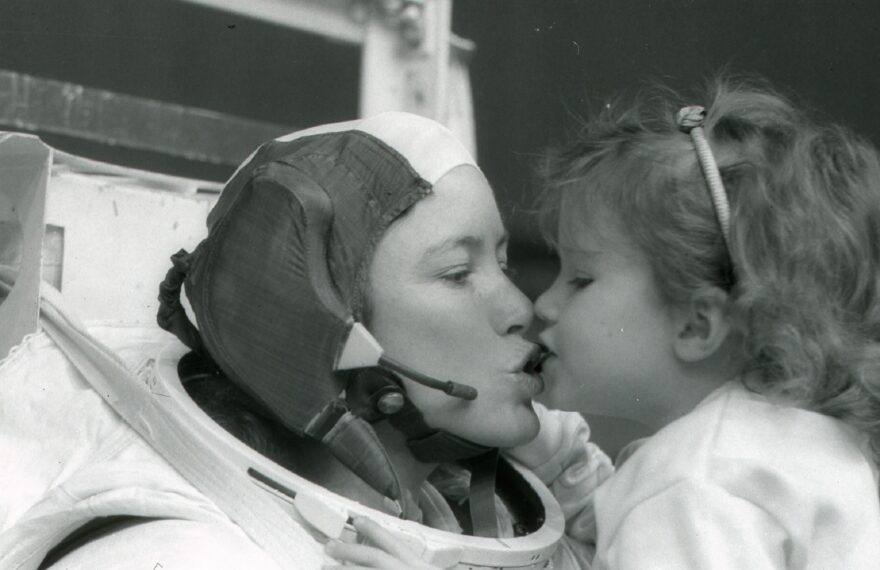
Anna and Kristin Fisher (NASA)
Did you find that maybe they didn’t expect to open up the way they did? I mean, at some point you have some of them watching some old archival videos and getting their genuine reactions. You see a lot of them reacting and then reflecting on all that they’ve accomplished. I think this is very poignant.
Yeah, I think a lot of the time astronauts have, certainly the people I was speaking to, a lot of them have told their story before in a TED Talk environment. They’ve got their 15-minute story, which they’re very used to telling. I needed to break that comfortable way of packaging the story for them because it doesn’t challenge them at all. And the way you break that is that you go into much more detail, you slow the whole thing down, and you explore things that perhaps they’ve not had been asked before or perhaps they’ve not connected those dots in that way before when you ask them to think about things. And what’s very revealing is when it happens in front of you and therefore in front of the cameras and they’re watching something and the way that they’re suddenly now reading that footage and discovering these feelings that perhaps they haven’t felt before. They might’ve felt them, but perhaps they’ve always been slightly more private. I think for many that took part, I think there was a sort of feeling that it was an interesting experience for them to be interviewed this way. And I think they found things out about themselves, which doesn’t happen when they’re doing the TED Talk circuit.
You get the sense they’re giving their candid thoughts on how things took place where you’re providing them the environment to do that. Towards the end, for example, Ginger Kerrick [aerospace executive and former NASA Flight Director] talks about the future of the space program where you’re providing the platform to be able to do that in this kind of environment. Sometimes people worry about, oh, is my job secure and things like that. But a lot of these people are also retired, so now they’re at a point where they can really open up and not feel that restraint.
I mean that definitely helps. There would be more probable concern from NASA if someone was a current astronaut. But yeah, for all the astronauts I spoke to, all the American astronauts I spoke to, I mean everyone has a huge amount of respect for NASA and you can still sense that. But yeah, perhaps now that they’re no longer working directly for NASA, they’re free to actually reveal a bit more about what it was like to travel into space for them and their feelings and those emotions that perhaps get probably mistakenly suppressed. You’d imagine actually everyone would be interested to know exactly what it was like for the Artemis crew to go around to the moon and we hear the correct soundbites from them, but no one really says that they were dead scared or anything like that, I suppose. Whereas now they can admit that.
What were the biggest challenges that you faced making this particular project?
Well, I mean a huge challenge was trying to get the cosmonauts, the Russian cosmonauts on board. Because it’s very difficult, as in impossible for me to go to Russia right now. It’s hard for me to go to Russia because of the war. And this series, being made for the BBC in Britain and PBS in America, that’s not viewed brilliantly inside Russia. They’re both broadcasters that are very aligned with their respective countries. But I reached out to the cosmonauts and many of them really wanted to talk. And so it was just a case of, so how do we make it happen? And the way we made it happen was we met in a neutral country, a country that they could go to without a visa and that I could visit. It’s much easier for me to visit anywhere, but finding a neutral country for them to go to for a few days where I could interview them. And it was slightly unclear whether they were doing it with the blessing of Roscosmos or just doing it because they wanted to do it.
I suspect it was a little of both. And I think when someone like Sasha Lazutkin said yes, there was definitely a sort of confidence built around the cosmonauts that, oh, perhaps this is okay. Perhaps we can engage with them. And getting to that turning point, knowing that I could tell the Russian side of the story in the same way that I could tell the American side of the story, that was definitely the biggest challenge.

Daniel Tani (NASA)
I feel that was so important to this story. I mean, you can’t tell the story without bringing them into it and having them involved or all you could have shown was archival footage and things like that. Much like how you talked to families in the United States, it’s much of the same with Russian families. There’s a lot of overarching themes where there’s a lot of similarities. So having that is I think really important to this, I’d say, in terms of understanding that side.
I definitely wanted the two to feel equal in terms of the attention that we gave. It was important that the cosmonauts didn’t feel like a smaller, less significant role just because we found it difficult to film them. That would’ve been a big mistake. So yeah, it was important to get them into the interview space. It was also really important to be able to film them a little bit outside the interview space like we did with the American astronauts, just so you can see their lives and ask them to bring their families and pull back the curtain of their domestic life and the pressures that went on for their family, just like the Americans were talking about. So that balance was crucial.
What was your big takeaway from working on this project?
There were a few. Space as an ideal, a place which is hard to access, dangerous and requires the best brains and the best communication and collaboration in order to access it, brings out the best in people. When America launched that shuttle, it wasn’t a coincidence that NASA wanted to have a multiracial, multi-gendered crew for that first one because it represents the ideal America, how do you say this? A representational version of America at that time. Modern, progressive, equal, democratic, and NASA understood the power of that. And they did it incredibly well. I remember as a child in Britain thinking that America was in the future. And that was how you viewed America from being abroad.
And as I made this documentary, I think what I thought was how impressive it was that countries could bury their political ideologies and their political differences in order to achieve something which no singular country could achieve. And that lesson, we are on the brink of throwing that away. That’s the danger, I suppose, where we are, where we’re no longer going to collaborate with Russia, we’re no longer going to collaborate with China. It’s going to become much more individualistic. But there was a beauty and a symbolism about the world coming together to achieve something. And I thought that was the most pertinent and moving lesson that I took from the documentary.

Given what’s happening right now with the Artemis and what the plan is over the next couple years, in addition to 2030 with what’s going on with the International Space Station, are there thoughts of doing a part five follow-up down the road?
Yeah, I mean it would be fascinating, wouldn’t it? It would be really fascinating. Yes. Sometimes I feel like we’re on the eve of getting rid of the International Space Station and we’re not clear what’s replacing it, whether it’s going to be another sort of collaboration or competing groups of individuals and nations with private businesses. That’d be a fascinating next installment, I think.
Before I let you go, I wanted to get an update on your upcoming project Once Upon A Time in America, which is very timely coming off of America 250. What can you tell us about that? What can you tease?
I am in the foothills of still trying to research that, but America is a country which has a huge impact on the rest of the world. What America does first, the rest of the world eventually will follow. And to understand America and therefore understand Americans right now feels important. We get a lot of stereotyping. I think we get a lot of lazy stereotyping about the left and the right in America. And I think a documentary that can get into the nuance and the humanity on both sides would be valuable.
Once Upon A Time in Space premiere, July 14, 9/8c, PBS




Conversation
Please read the TV Insider Community Guidelines.
Register or sign in to join the conversation.
 Watchlist Easy access to only the shows you care about — all in one simple place
 Alerts Only important notifications — when a show is returning, when it becomes available to stream, and more.
 Special Offers Exclusive products we release related to your favorite shows and streaming services