
‘Game of Thrones’ Spinoffs Are Making up for Franchise’s Initial Dismissal of Queer Characters




Opinion
There are plenty of changes the recent Game of Thrones prequels, House of the Dragon and A Knight of the Seven Kingdoms, have set into motion. From characters who were present in George R.R. Martin‘s novels not appearing on screen to motivations being completely changed, there’s a lot for book fans to get frustrated about when it comes to their favorite fantasy world being adapted. But, there is an admirable change taking place in these new adaptations, one that the Game of Thrones writers were too afraid to do; these new shows are finally amplifying the queer subtext and text that was always present in Martin’s work.
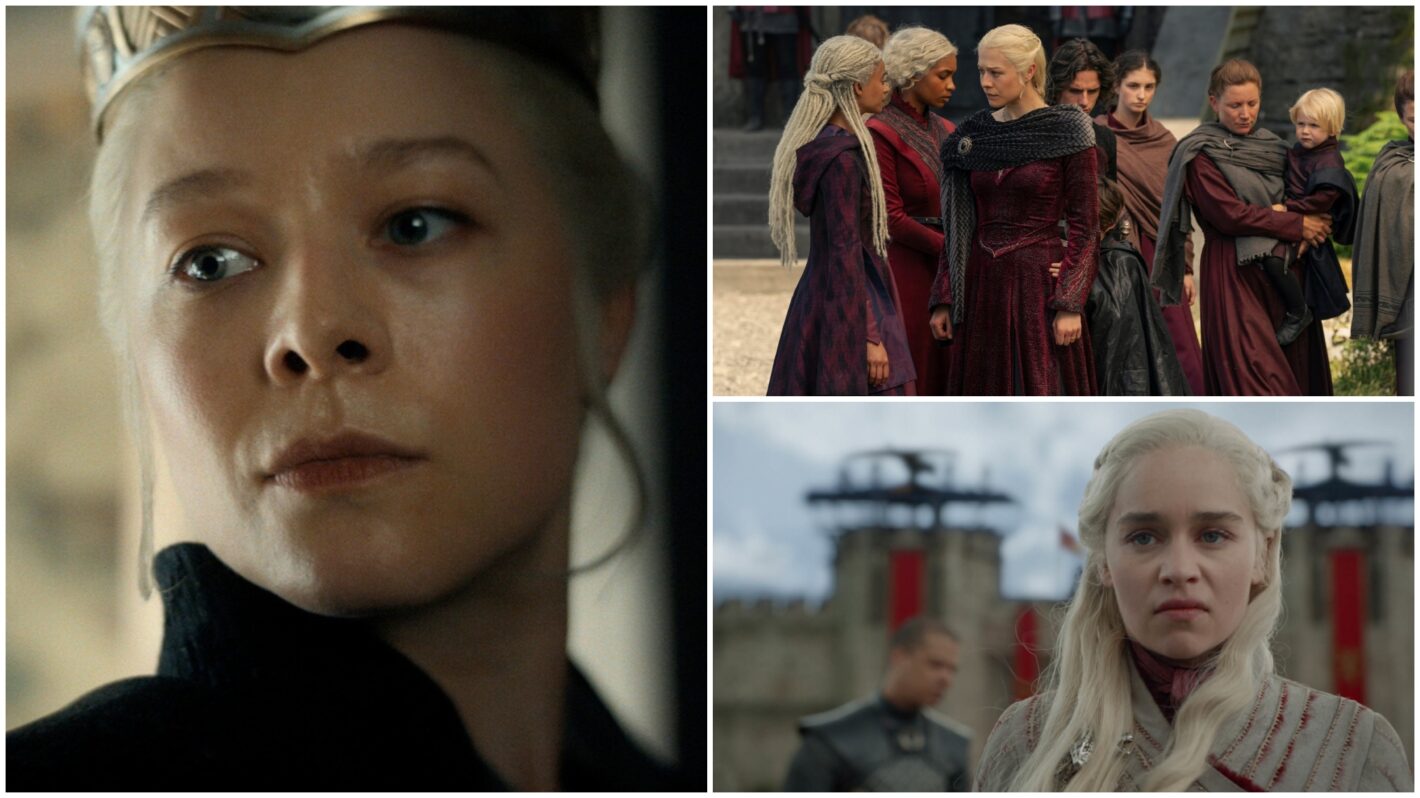
For a series of novels that were first released in the 1990s, Martin’s A Song of Ice and Fire series was ahead of the curve with its representations of queer characters. These characters exist along the margins and are fully fleshed out beings, ranging from Cersei Lannister’s (Lena Headey) burgeoning bisexuality to the understated and tragic romance between Loras Tyrell (Finn Jones) and Renly Baratheon (Gethin Anthony). While one of these did indeed get reflected on the screen on Game of Thrones, Cersei, like Daenerys Targaryen (Emilia Clarke) and Xaro Xhoan Daxos (Nonso Anozie), had her queerness stripped from her. Paired with them, queer characters like Satin and Jon Connington were completely erased from the series.
This isn’t to say that queer characters didn’t exist on Game of Thrones, but when they did, their same-sex attraction was used to showcase how unlike the rest of Westeros’ population they were. When Oberyn Martell (Pedro Pascal) comes to King’s Landing to avenge his sister, Elia Martell, he’s introduced while engaging in group sex with his paramour Ellaria Sand (Indira Varma) and male and female sex workers. Paired with Pascal’s complexion, Oberyn’s same-sex attraction is used to show the audience that the people of Dorne, despite it being a part of Westeros, have different customs.
The same can be said for Yara Greyjoy (Gemma Whelan), whose screentime over the show’s eight seasons often saw her wielding an axe, attempting to gain control over the Iron Islands, and of course, having sex with women. This was a deviation from her book counterpart, who isn’t queer, and, again, used not for representation’s sake, but to showcase to audiences that Yara is unlike the other female characters in the show. With Oberyn and Yara, writers David Benioff and D.B. Weiss used the sexualities of these characters to “other” them. Each time they made eyes at someone of the same sex, the show seemed to welcome its audience to gawk at the strangeness of these actions in an overwhelmingly straight television show.
Ollie Upton / HBO
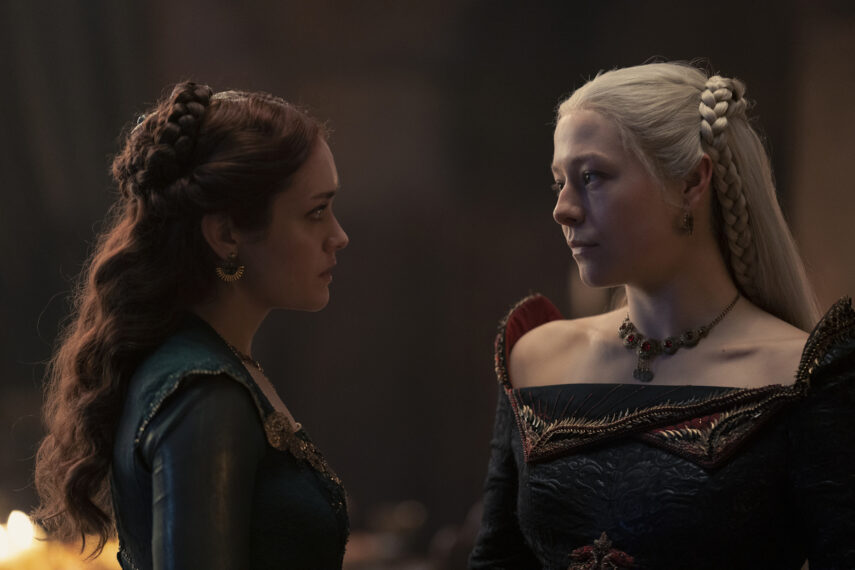
Thankfully, the tides are changing, and both of the other two series in this ever-growing franchise have slowly begun to change how queerness is presented and viewed within the world of Westeros. From its first season, House of the Dragon has felt like a soapy queer love story between Rhaenyra Targaryen (Emma D’Arcy) and Alicent Hightower (Olivia Cooke). Writers Ryan Condal and Sara Hess changed the timeline so that the two were once childhood friends before they became step-daughter and step-mother, and in doing so the adaptation has become a tragic story about two women who may or may not be in love with each other, who have been forced onto opposite sides of the war that leads to the death of House Targaryen’s dragons.
Paired with Rhaenyra’s first marriage to Laenor Velaryon (John Macmillan), who was textually gay and helped raise three children with his wife and her lover, Ser Harwin Strong (Ryan Corr), the series views queerness as a natural aspect of these characters. This continues in Season 2, when Rhaenyra and Mysaria (Sonoya Mizuno), who was once Rhaenyra’s second husband Daemon Targaryen’s (Matt Smith) lover, share a passionate kiss. Through this romantic relationship, Mysaria becomes Rhaenyra’s right-hand woman, not only aiding her in her quest to take back the Iron Throne from her half-brother Aegon Targaryen (Tom Glynn-Carney), but also giving her the unwavering companionship she has been searching for her whole life.
The affection — whether it be romantic or strictly sexual — these characters have for people of the same sex is a beacon that shines through a show that has otherwise quite dire circumstances. In this version of Westeros, queer people exist just as naturally as kings, queens, and dragons do. The same can be said for HBO’s newest adaptation of Martin’s work, A Knight of the Seven Kingdoms. While there’s less to work with than House of the Dragon, this series introduced audiences to Lyonel Baratheon (Daniel Ings), an earnest and eccentric lord who, from their first meeting, is infatuated with Ser Duncan “Dunk” the Tall (Peter Claffey).
After a night of drinking, a dance party breaks out in Lyonel’s camp. It’s then that he makes what could be considered a move, twirling his body around Dunk’s feverishly, his gaze never pulling away from his dancing partner. Although Dunk has eyes for Tanselle (Tanzyn Crawford), Lyonel dedicates himself to his new friend’s cause when a Trial of the Seven is called against him, not only because he doesn’t want to miss out on the first trial of seven in a hundred years, but because he’s enamored by the young man. Lyonel, like Rhaenyra, Mysaria, and Laenor, is brash, proud and quick to anger, but these flaws aren’t tied to his queerness; they are inherent parts of him, just like his sexuality, and just like they’re inherent qualities of many characters in this universe.
Lyonel’s presence, paired with Aerion Targaryen (Finn Bennett) making eyes at Dunk during their first meeting, and two knights describing Aerion as “pretty,” are all representative examples of how inklings of queerness were sprinkled throughout A Knight of the Seven Kingdoms. This subtext is injected into the show authentically, proving that there has always been space for queer characters — no matter how fleeting their relationships or flirtations be — to exist within this universe. With both of these series, HBO’s most recent adaptations of George R.R. Martin’s work proves that we live in a new age of adaptations where queer characters aren’t just simply allowed to exist, they are allowed to explore these romantic interests like any other character would, instead of being relegated to the shadows of these shows.
Strides have been taken by both of these series to not only treat these characters and their sexualities with care, but also to allow them the same room to be as volatile as all characters in this expansive universe are. In these new Game of Thrones spinoffs, queer characters are morally corrupt and flawed just like their straight counterparts, yet it’s clear it’s not because of their queerness that they are this way; it’s because they exist within the fractured world of Westeros. By allowing queerness to take shape in this universe, the franchise has finally become the queer pillar of fantasy television that it was always meant to be, ushering in a new era of the genre, and finally doing justice to one of the most groundbreaking aspects of George R.R. Martin’s work.
House of the Dragon, Sundays, 9/8c, HBO and HBO Max
Conversation3 Comments
Please read the TV Insider Community Guidelines.
Register or sign in to join the conversation.
-
T
Wow
So important
2
-
H
I was never a fan of the series as it had so much gratuitous violence and overwrought sex...elaborate porn essentially, but its very disturbing to learn that the original series made a conscious choice to ghost some or all queer characters or story lines? I can't imagine how such behavior made a writer of Martin's stature feel? Wow...that's amazingly cowardly given the brazenness of the rest of the show. What a pity the arts still sometimes lose a backbone when it is needed most. It is typically the arts that blaze the trail and it is good news that spin offs are making the right effort to honor Martin's original spirit. Thank you!
-
A
Had it been someone the leftist media doesn't worship like Pelley, the headline would be 'xx finds himself out of options, signs with agent'.
 Watchlist Easy access to only the shows you care about — all in one simple place
 Alerts Only important notifications — when a show is returning, when it becomes available to stream, and more.
 Special Offers Exclusive products we release related to your favorite shows and streaming services