
‘Ponies’ Creators Talk That Cliffhanger Ending & Season 2 Plans



Exclusive
What To Know
- All eight episodes of Ponies, a new spy caper set in 1970s Moscow, hit Peacock last week.
- Here, cocreators David Iserson and Susanna Fogel talk about that cliffhanger ending and their hopes for what’s next in a hypothetical Season 2.
[Warning: The following post contains MAJOR spoilers for all eight episodes of Ponies.]
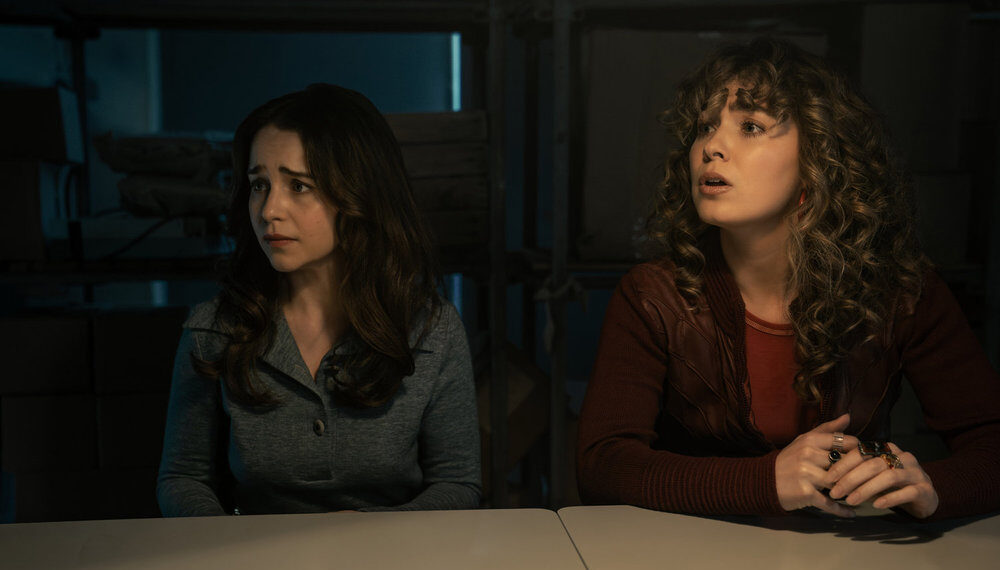
The girls are in trouble now. After crashing Elton John‘s Moscow concert dressing room, narrowly avoiding being murdered by Andrei — who’s been storing kompromat of other KGB officers in shampoo bottles — and bringing him back to CIA headquarters, Bea (Emilia Clarke) and Twila (Haley Lu Richardson) seemed ready to end it on top… until the twists started coming.
Bea’s supposedly dead husband Chris turned up still alive, and he may have been collaborating with the KGB and also responsible for the murder of Sasha’s sister! Plus, Cheryl was a double agent! And the CIA headquarters has been bombed, with KGB agents raiding the place while Andrei holds the gals at gunpoint!
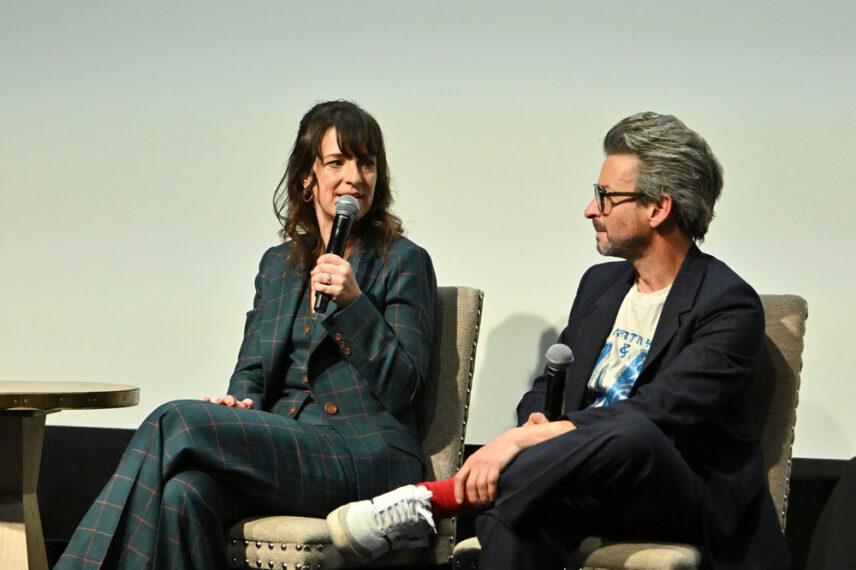
There was a lot to take in about the final moments of Ponies, so to break down the biggest moments of the season and get some clues about what might be next after that cliffhanger, TV Insider caught up with cocreators Susanna Fogel and David Iserson.
Part of the journey in Ponies is it’s a period story with cultural elements throughout. Obviously, the big one is Elton John. How did you come to the decision to include those little revisionist history moments, and was there anything you wanted to include but couldn’t?
David Iserson: To the first thing, we narrowed in on wanting to set this in the late ’70s, which is just a time period I think we just both have a lot of interest in. We love the aesthetic of it. We like what it says that it is the spirit, this fulcrum point with feminism, as far as how it affects these characters. There was a lot of conversation about women in this time from a cultural perspective that didn’t always exist in their lives. They still existed in fairly traditional marriages, while I think there was probably a lot of writing and movies and books that made it seem like culture was more advanced than it was, so that was just a really exciting time. So I really love the music, we love the aesthetic, and we really wanted to tell something about it.
As we narrowed in on it, we’re like, “Oh yeah, there was an Elton John concert in the ’70s in Moscow. Wouldn’t it be exciting to build something into our story about it? There was a fire in the embassy in 1977; how do we build a story about it?” So I think it’s a really interesting way of viewing a period of trying to define the truth and blending our fiction with it, and just trying to see how these things marry. I think it allows research to kind of take on real life.
As far as if there’s something we didn’t incorporate, I would say not really, because our hope is that we can do this show for many more years. So we have a lot of things in our back pocket that we didn’t yet explore, but that we would be excited to explore.
Any you want to share?
Iserson: No because we want to surprise people. I think that the hint is of it is that in researching what the American Embassy in Moscow dealt with in this time period, there are just some great, true things that really excited us that we weren’t able to get going but is widely available, and lots of books that exist about this time period in Moscow.
With Twila, a lot of her journey throughout the series is her sexuality, and then also coming to terms with her own past and having the abortion and what that did to her future. There’s a lot of nuance to it, but it’s also pretty straightforward how she approaches things. How did you bring these threads together in such a quirky and unique way with this character? And why is it that this wild experience that she’s going through actually seems to really ground her and help her through that?
Iserson: I felt very close to Twila as a character. I’ve definitely known people like her. … She uses humor as a shield. And she also is somebody who, before the events of the show, was always making decisions to run away from something. Her arc is much more about trying to find something to run towards… So much of what she wanted was not this. Her marriage was an extension of trying to get out of her past.
A lot of the conversations that we had as far as her sexuality and as part of her just even finding her purpose, was that she was not making those decisions in her life, because she was sort of using her sexuality and her sexual desirability as means to to become somebody who is living abroad and having an exciting life, but that is always a means to an end. And so she’s somebody who these people are very delighted by, but ultimately don’t trust and don’t like.
And so her journey, because all of those things are named early on in the show, is to become more introspective and to find a lot of who she is through a real close friendship, through her closeness with Bea. We talked about her always kind of being the life of the party, but never really truly having friends in a real way. And so her growth really comes with her relationship with Bea.
When she opens up in the finale of Season 1 and talks about the secrets of her life, I mean, it is a real counterpoint to the story that she tells Bea in the pilot — the different version of her marriage, that is the narrative that she tells everybody — because she would never find value earlier in her life of telling the truth, of truly allowing herself to be kind of words and all honest with somebody, because that was just not not a means to an end.
So to us, it wasn’t just revealing this sort of straightforward truth about her, her marriage, and the choices that she made, but allowing herself to present herself as this flawed person who has a secret, and knowing that Bea will still love her the next day because this is a true friendship, and I think that is a lot of where that conversation comes from.
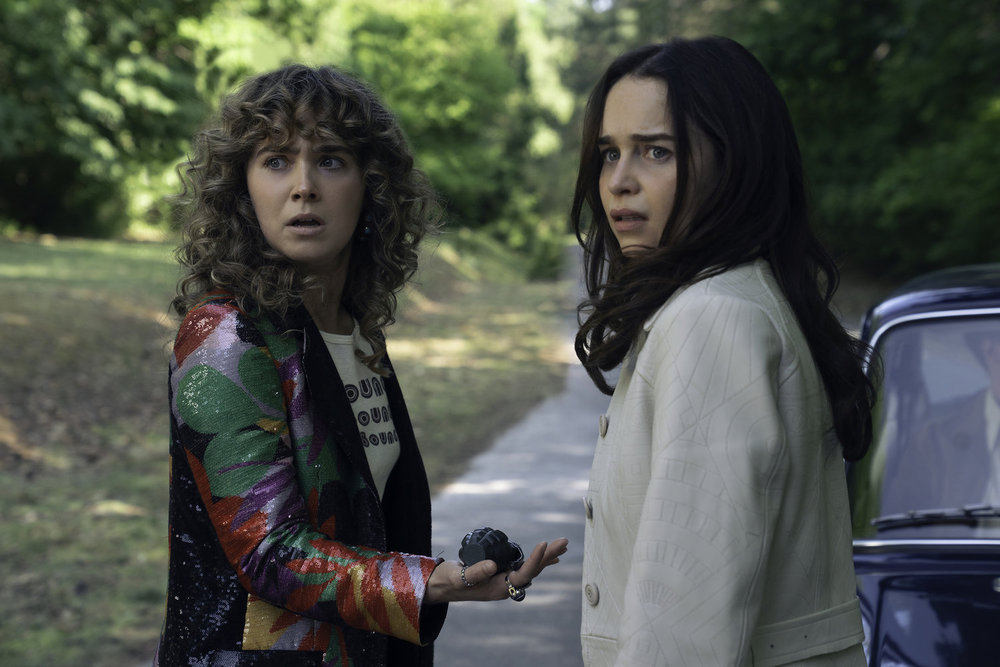
For Bea’s side, part of her journey is learning to care about someone else again in Sasha, but also coming to terms with the things she didn’t know about Chris. So, what do you think, at the end, her true mindset is? She seems still conflicted, even to the last minute. Where do you think she lands? Or is she still in the process of discovering that?
Iserson: I think there are moments in the season where I think Dane interrogates what her real reason behind doing this — risking her life, working for the CIA… The story she’s telling herself is, “This is about Chris, this is about the love of my life. This is about finding these answers.” And Sasha, who is somebody that is probably is not the kind of person that she would have ever met in her life otherwise, connects with her in ways that surprises her and that she was not expecting — kind of opens up a opens up a lot of emotions for her, as well as just having to build this lie with Andrei that, because Chris just was so perfect on paper, but maybe is not truly everything she thought she would be. And I think her journey is probably much more towards finding an identity that is beyond her romantic relationships with men, but that is the journey that she goes through.
I think where we are setting her up for Season 2, and knowing that Chris is alive, and knowing that that information is going to come back towards her, one way or the other, and how she is going to grapple with it, she is a much different person than she was when the show began, where the hope that Chris is alive and the information that Chris is alive would be something that she would be the wish that she tells herself come true. And I think the person that she is at the end, when that information comes, she has kind of lived a lot more life, and that is not going to be information that she is just to start that sense again, that is information that she is going to receive in a much more complicated way.
Bryan Bedder / Peacock
Andrei, as a villain, was so complicated and dangerous and scary, but also he was a little bit naive at times, because sometimes Bea was not always good at hiding her true self from him. He didn’t seem to notice… or did he? He seemed almost a little bit bemused and maybe even impressed that she is an American, and she got the one up on him. If you were to continue in Season 2, what do you look forward to exploring with that dynamic with him?
Susanna Fogel: One thing that we’re really excited about is just exploring the complexity of the power dynamics between the two of them. And adding a layer to that, obviously, he has an immense amount of political power. Throughout Season 1, she has a certain allure that is power over him, but also, she feels overpowered by what he’s capable of. And then there’s this moment where they think that they have him under their thumbs at the end, and then there’s one last one-up, but at the same time, they still have a secret about him.
So they’re both holding a lot of secrets. And I feel like playing with who has the power in what situation, and who can blackmail whom, and what each of them wants moment to moment, it’s really complicated in Season 2 in a way that I think is in a world where we’re still sort of drawn to the chemistry that they have, in spite of everything we’ve seen. It’s going to feel, hopefully, exciting to watch those little moves, and it’s not clear who has power in that situation, just based on the cards that each of them holds. And we want to keep that really complicated and, episode to episode, be exploring the ways that each of them can sort of control the other.
The series ends with a lot of cliffhangers. Andrei escaped; the girls are being held at gunpoint; there are question marks that still exist with Dane and Cheryl. What should fans expect from that?
Iserson: So, bunch of things. So they feel they have the upper hand on Andrei, but he turns the tables on them; we see this shampoo bottle at the end, and we know that maybe they still do have one more card to play, as Susanna was saying. So he escapes, but it’s still possible that, you know that all is not lost. They’re being held at gunpoint, and the KGB is stealing these documents from the CIA. So we’re wondering how the KGB is going to use those documents, what they’re going to find out, what they’re going to discover, who is going to be put at risk there, how that affects all of the operations of the Americans in the Soviet Union and abroad.
We still have this very wide blackmail operation that Bea has discovered its location. We kind of understand that it is incredibly vast, and you know that the Soviets are able to leverage powerful people all over the world, and what that means going forward. We’ve learned that Dane has some secrets. He’s suffering emotionally. He’s suffering with mental illness and suicidal ideation, and also a lot of that guilt built up, and Chris being dead, but then he finds out that Chris is alive, and [we have to see] how that affects him, and how that makes him vulnerable.
And is he as all-knowing as we think he is? And what it means that Cheryl has been working for the Soviets now, and we have this moment with her and Ray, where Ray says that he is going to trust her implicitly going forward, but we know that how dangerous that is, that Ray is such a good and noble person, but that his flaw is that he is putting his implicit trust in somebody who we now know is extremely compromised and is willing to do terrible things, and we wonder why, and we wonder why Cheryl was turned, and what her being turned means and could do going forward. And so we have a lot of these things to explore!
If the show does return for Season 2, do you think you’ll try to explore outside of Moscow and the embassy a bit more?
Iserson: I don’t want to commit to that one way or the other. I think, I think truly this, that Moscow is the home base of the show. And, yeah, there may be more to explore as we widen out, but I think it still is very much a Moscow show.
Thanks for your time… I loved the costumes and decorations. It made me want to redecorate my house — Moscow midcentury modern style.
Fogel: For them, it was just modern!
I also need to get Twila’s shirt from the club scene.
Fogel: Our costume designer was really incredible. It just, the looks of the show were so… There’s more than one occasion where David and I would have some like event to go to, lone of us would be going out of town for the weekend when we’re in Budapest or someone’s birthday party, and we just would go in the costume department and be like, “an we please borrow something or everything?” So yeah, it was really hard not to rifle through the clothes for the show. [Laughs.]
Ponies, Season 1, Now streaming, Peacock









 Watchlist Easy access to only the shows you care about — all in one simple place
 Alerts Only important notifications — when a show is returning, when it becomes available to stream, and more.
 Special Offers Exclusive products we release related to your favorite shows and streaming services