
‘Spartacus: House of Ashur’ Stars Talk ‘White-Hot Vengeance’ After [Spoiler’s] Death



Q&A
What To Know
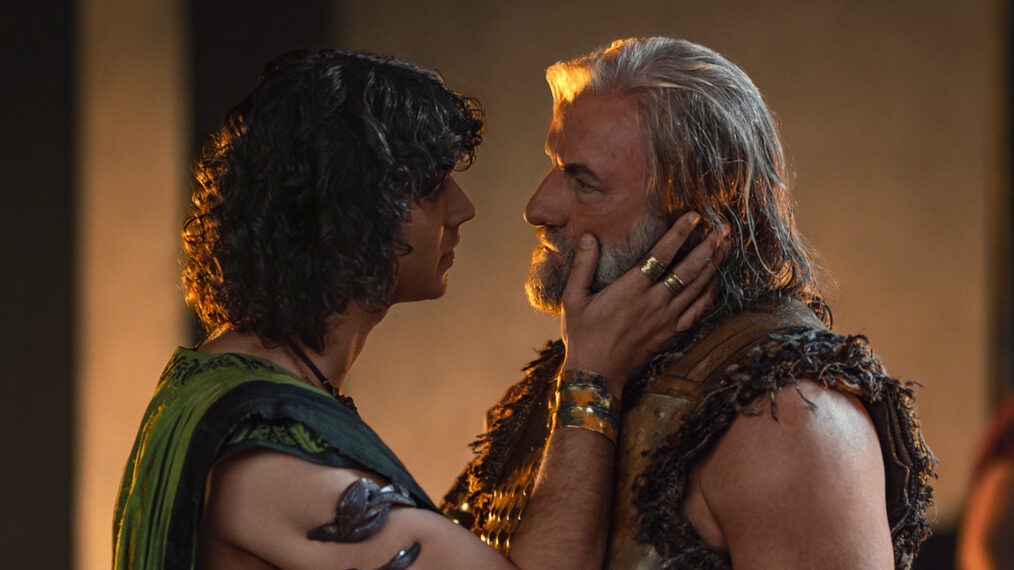
- Korris (Graham McTavish) and Opiter (Arlo Gibson) fell in love in Spartacus: House of Ashur and were ready to leave Capua for a new life together.
- McTavish and Gibson break down the Korris and Opiter relationship and explain the “white-hot vengeance” exacted in Episode 7.
- McTavish warns there are “nasty things coming” in the last three episodes of Season 1.
[Warning: The following contains MAJOR spoilers for Spartacus: House of Ashur Season 1 Episodes 6 and 7.]
A gladiator-turned-gladiator trainer was deeply committed to his ludus until love came along. And then, that tenderness made him want to leave his life behind and start anew in less rough emotional terrain. Korris (Graham McTavish) was a stone’s throw away from a happy ending with his lover, Opiter (Arlo Gibson), in Spartacus: House of Ashur Episode 6, but his enemies in Capua murdered Opiter the night they were meant to start their new life.
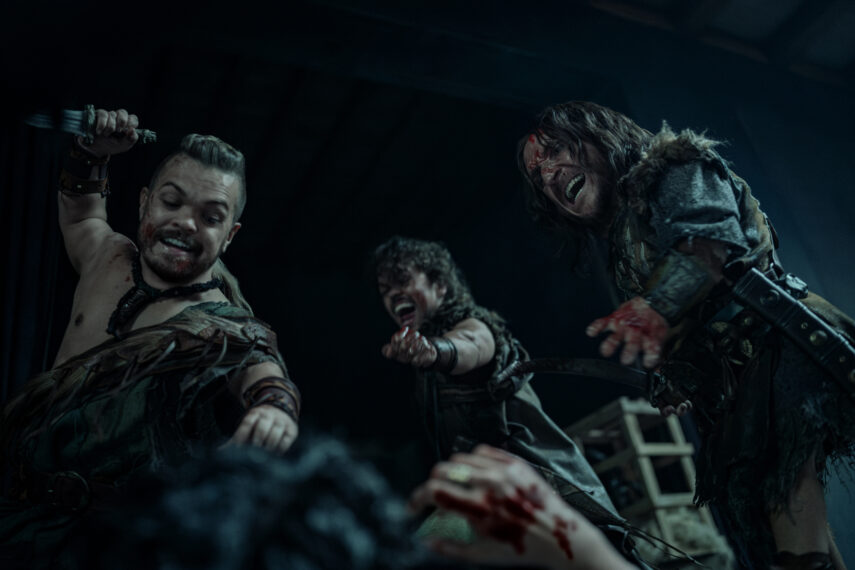
It was a tragic scene seeing Korris bid Ashur’s ludus and their gladiators farewell, knowing what was waiting for him on the other side. The Brothers Ferox had brutally slain Opiter in his home under the cover of night in Episode 6. When Korris and Ashur (Nick E. Tarabay) arrived at Opiter’s home at the beginning of Episode 7, they arrived at the bloody nightmare. Korris was inconsolable for a week after. By the end of Episode 7, he exacted his revenge and put an end to all but one of his lover’s killers in a gruesome nighttime battle in the arena that was completely in Spartacus style. He let one Ferox brother, Satyrus (Leigh Gill), survive to send a message to those who would dare to cross him again.
Here, McTavish and Gibson look back on Korris and Opiter’s love, how it changed their characters forever despite the tragic ending, and look ahead to the final episodes of House of Ashur‘s first season, with TV Insider. McTavish warns that “there’s a lot more nasty things coming” after this pivotal episode.
It doesn’t take much convincing to get Korris to agree to leave with Opiter in Episode 6. Why was it such an easy choice for both of them to leave their lives behind together?
Graham McTavish: I don’t think it was necessarily easy. The choice that they make really comes from the fact that they’ve surrendered themselves to real love, a kind of love that doesn’t exist much in the world of Spartacus. There’s always politics, there’s always manipulation, there’s always, what can I get from this? Arlo has spoken about this before, which is very true, with that being stripped away and them actually exposing their mutual vulnerabilities, then making a decision like leaving together and starting a new life, it’s almost obvious. Why would we stay?
We’re surrounded by things that have only given us misery and worry and all the rest of it. Let’s start again. And it’s a bold move, which sadly goes slightly wrong.
Arlo Gibson: Opiter is exhausted by the way he is navigating Capua. Obviously, there’s the threat to his life with Caesar gunning for him, but all of this wheeling and dealing, Opiter is always presenting a facade. And with Korris, it’s like he can finally let that go and be himself. To taste that for a character that deals so much in manipulation, the choice becomes obvious for him because there is true happiness in it as opposed to the happiness gained by manipulation and navigating power. For Opiter, that choice becomes clear when the heart opens.
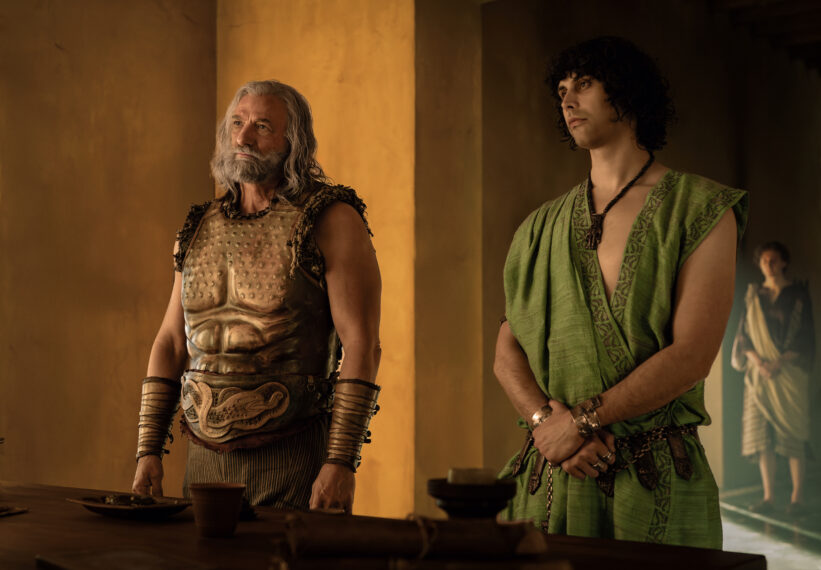
McTavish: He’s right. It’s an exhausting world for both of them. Someone like Korris only realizes how exhausting it has been when he’s shown someone like Opiter and the alternative life that he could have for himself. I think that resonates with lots of people, not in such extreme circumstances, but the choices that we make in our lives, sometimes when we’re offered a different choice, a different path, you think, “Oh, well, maybe actually that’s what I’ve been looking for all this time.” He has been looking for someone like Opiter to actually give him permission to leave.
Starz
Loving yourself isn’t enough sometimes. Sometimes you need someone else to break you open.
McTavish: Absolutely, 100%.
Gibson: Absolutely.
What was your favorite Korris and Opiter scene, and why does it move you?
McTavish: We were very lucky with our directors in those scenes. Everybody was really focused on trying to find the subtlety in it because, with no disrespect to other romances in Spartacus, some of them lack subtlety. They’re a little in your face. This was a real opportunity for us to explore that tentativeness and nervousness and just worrying about exposing yourself to someone. So, I don’t know, favorite scene? The bath scene was really good. I really liked the bath scene.
Gibson: The bath scene was amazing. I think also when I invited you back to my villa under the guise of getting more grain, how that scene starts one place and the journey those characters go on over the course of that meeting and evening, that was really rich. It was not only meeting each other for the first time, but feeling out what that relationship could be. That scene was really juicy and exciting for me.
McTavish: Yes, yes, because we came with possibly different, or we weren’t sure where this was going to lead, and we discovered where it was going to lead during the scene. We didn’t have an endpoint in mind. “Oh, this is where I want to get to at the end of this conversation.” It actually happened quite naturally in the writing, so that was a good one.
It’s so tragic watching Korris walk out of the ludus at the end of Episode 6, knowing what he’s going to find when he reaches Opiter. When did you both learn about Opiter’s fate, and what was your reaction to reading the script for the first time?
McTavish: Oh, gosh. When did you find out, Arlo?
Gibson: I think Steven [DeKnight] had an idea of the arc, but I didn’t know how or when it was going to happen until those scripts came out. And when I read it, I was like, “Oh my God, the Brothers Ferox setting in on me?!”
McTavish: Like a pack of hyenas. I definitely knew a couple of episodes in advance that that was going to happen. I’m not sure if I knew when we were doing the scenes that we’ve just described. They would keep stuff back, definitely. You wouldn’t just get seven episodes in a chunk. You would be getting them staggered. I think that’s really important, actually, because otherwise it obviously informs how you play scenes if you know that the person you are acting with is going to be dead in a couple of episodes.
I can’t speak for Steven, but perhaps he wasn’t sure whether Opiter was going to die. That’s a great thing about writing is that sometimes the characters speak to you and say, “Actually, this is probably what should be happening now in this story.” It’s the beauty of writing.
Gibson: I really love the arc of Episode 6, though, within Korris and Opiter’s storyline. It’s like an absolute rollercoaster, so in terms of an episode to go out on, in terms of storytelling, I really love Episode 6. It’s a great one.
Starz
Graham, was the scene in the arena where Korris avenges Opiter in Episode 7, one of the most cathartic battle scenes you’ve ever filmed? You’ve, of course, filmed many.
McTavish: One hundred percent. Oh my god. Yeah. I couldn’t wait to do it. It was such fun. A really big shout-out to the guys, the Ferox brothers, Mikey, and all the rest. They were just so great to work with. It’s funny how much humor comes into play when you’re actually doing these terrible, awful, violent scenes. There’s an enormous amount of humor involved. I have photos of us all afterwards, covered in blood, smiling, and laughing. But from a character point of view, oh my goodness, yes. He comes into that scene with a white-hot vengeance, just everything he’s ever learned, everything he’s ever experienced as a former gladiator, and all the rest of it is brought to bear in that moment that there is no room for pity.
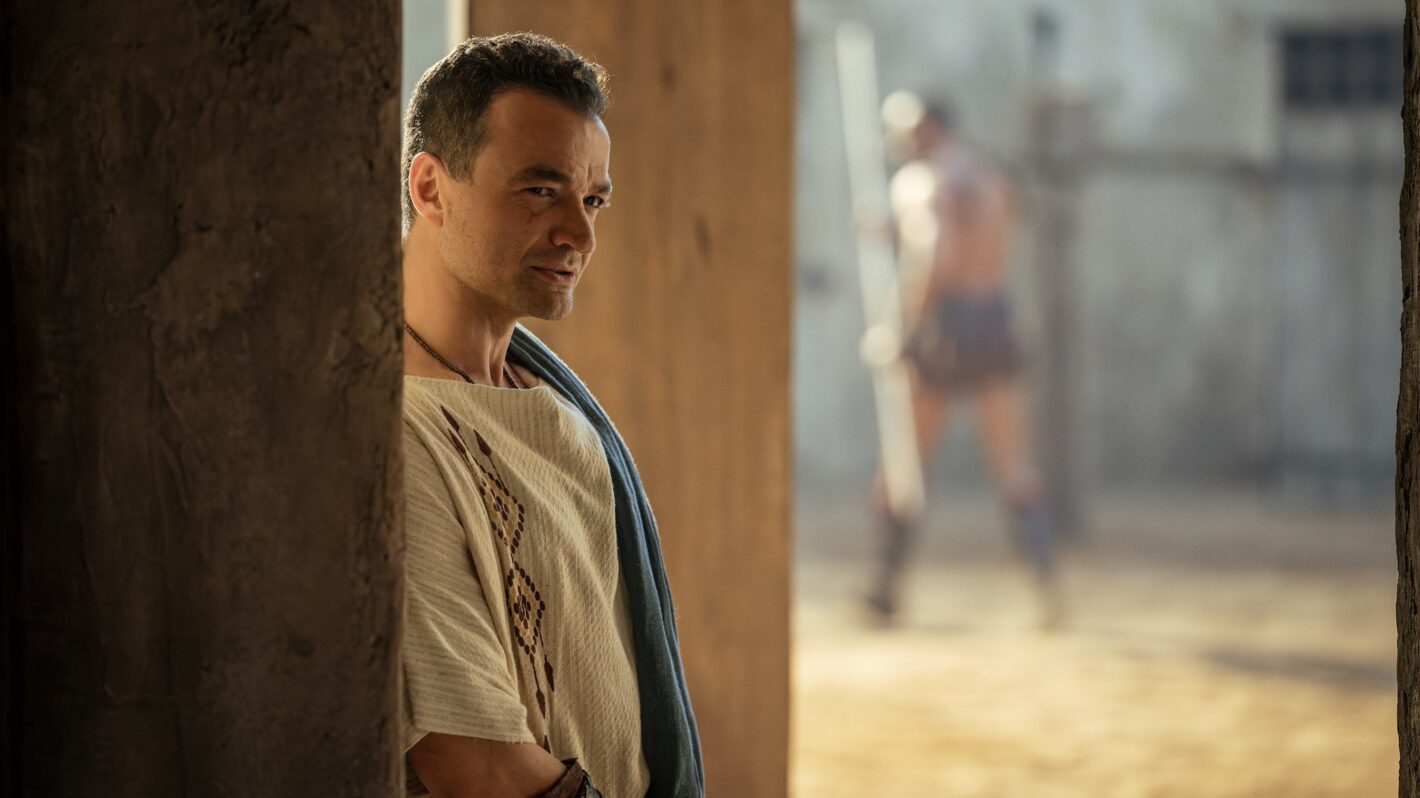
Even the sparing of Lee’s character at the end is very calculated. It’s very deliberate. He wants him to suffer as he is suffering. One of my favorite lines that Korris delivers is when he’s killed the two brothers, and he’s standing in front of the last remaining brother and says, “You stand alone, little man.” It’s so chilling because it is delivering a line which is saying, “There is nowhere, there is nothing you can do to stop what is about to happen. Your fate is sealed. And I’m in charge of that fate. I can kill you. I can spare you. I can do whatever I like.” It’s a great moment for Korris because he’s looking to the future. He’s very upset, obviously, but in that moment, he’s thinking, “How can I make this work for me in the future?”
You know the threat is real because they’ve driven him to the point of not caring if he dies.
McTavish: Oh, absolutely. Yes, because he has to get through all the other gladiators first. There’s like three of them, and then he has to get … Yeah, so he doesn’t care. He’s lost all caring for his own safety.
Arlo, how do you think Opiter would want to be avenged? And Graham, heading into Episode 8, is this revenge plot going to continue? We see him recommit himself to the house of Ashur, but I wonder what’s up his sleeve, if anything.
Gibson: Opiter would certainly be conflicted. There would be a part of him that would desire someone to walk to the end of the earth to avenge him. But at the same time, that’s maybe one aspect of Opiter, and there’s definitely another one that would just want Korris to take everything and leave Capua and find happiness for himself wherever that may be. And I hope that would be the part that would win out.
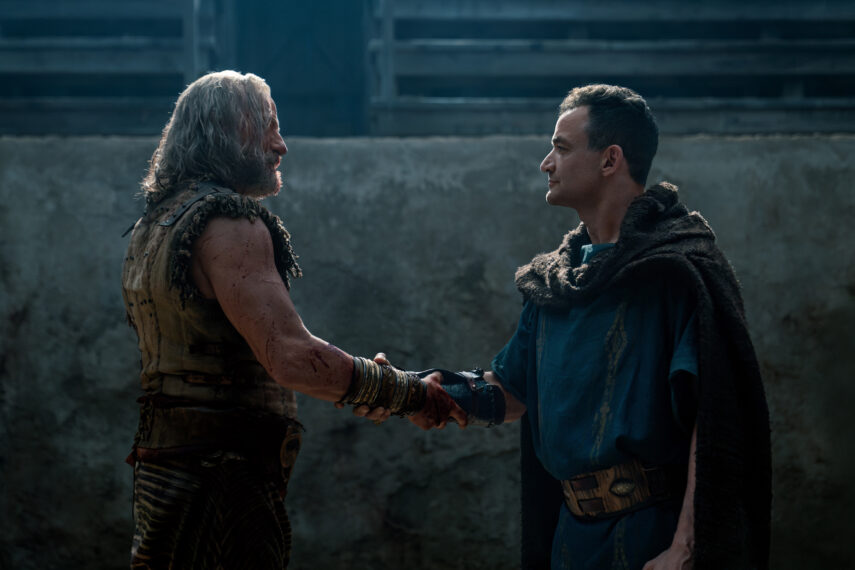
McTavish: You are absolutely right, Arlo. For Korris, that moment of choice, he could still leave. He could leave brokenhearted, but he could still leave, but Capua pulls him back in, really. The web of Capua ensnares him again. Going forward, you’re not exactly sure where that’s going to lead. But his ambitions, he’s now tying himself much more closely to Ashur, the ambition for the ludus, their own personal ambitions. The relationship between those two characters becomes much more interesting. There was another layer shown with the death of Opiter in [Ashur’s] relationship with Korris. That’s very important. And oh yeah, there’s a lot more nasty things coming.
Starz
It’s Spartacus, so I imagine so.
McTavish: Oh, yeah. Yeah. Just thinking about them, I’m like, “Oh boy, yes.”
Gibson: No one walks away [laughs].
McTavish: The great thing about this show, from my point of view, and I’m sure it’s the same for Arlo, is when I would read the scripts, there would always be a moment in every episode where you would go, “Oh God, no, I cannot believe that they’re going to do that. No! What?”
Gibson: Yes, certainly.
McTavish: That’s great fun to work on and watch.
It was really fun to watch you together this season. I’m sad that Opiter’s dead.
McTavish: Aw, I know. I’m going to build a monument to him, a twice-life-size statue of Opiter.
Gibson: [Laughs]
Get the curls and everything.
Gibson: They’re going to be hard to sculpt!
McTavish: [Laughs] All right.
Spartacus: House of Ashur, Fridays, 9/8c, Starz, Streaming Fridays at midnight on the Starz app





















 Watchlist Easy access to only the shows you care about — all in one simple place
 Alerts Only important notifications — when a show is returning, when it becomes available to stream, and more.
 Special Offers Exclusive products we release related to your favorite shows and streaming services