
Why Did Clowns Terrify the Internet in 2016? Hulu’s ‘Clown Panic’ Explains



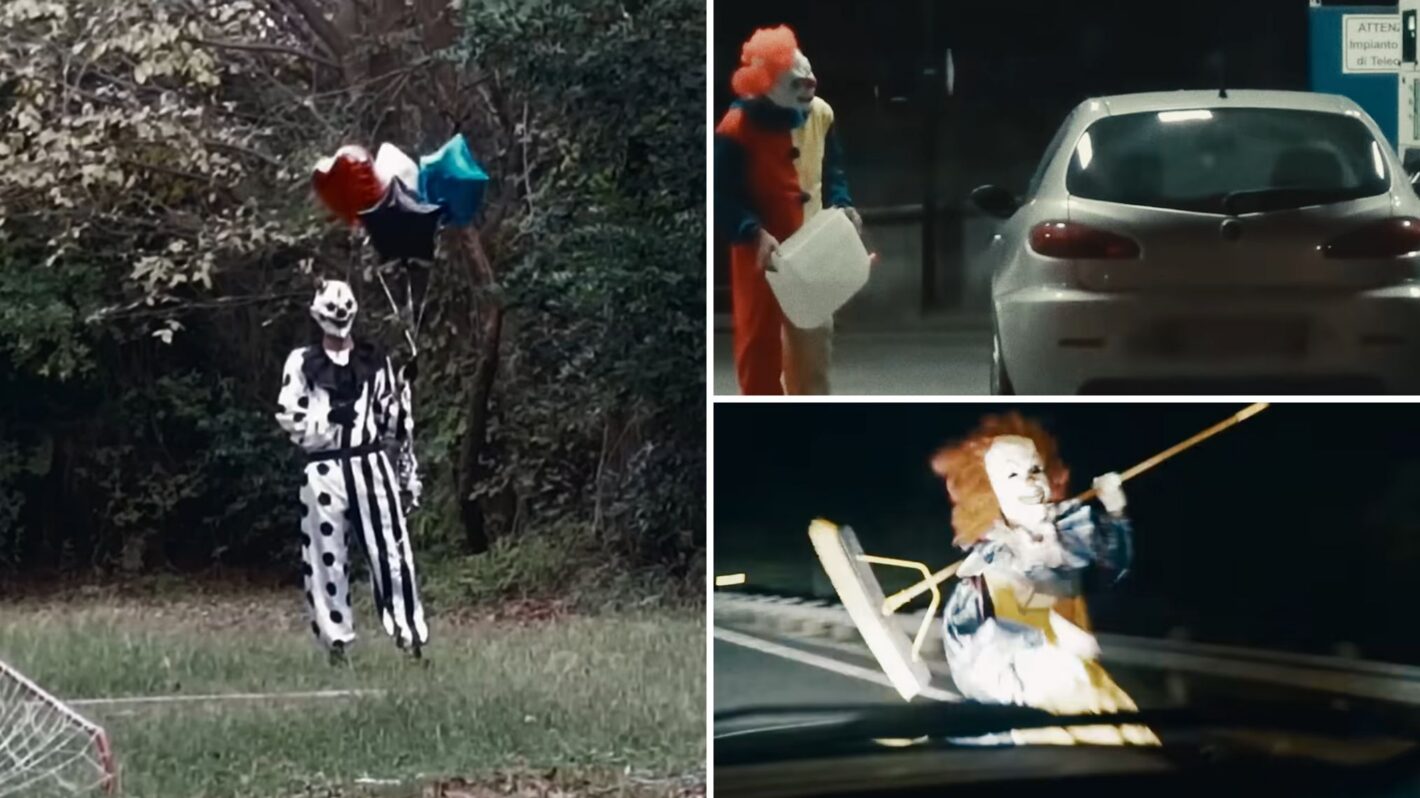
Coulrophobes, watch out. Monday, October 12, brings the premiere of Clown Panic, a Hulu documentary about how some nefarious Bozos had communities across the United States anxious about killer clowns in the fall of 2016.
So what exactly happened that inspired this rash of fear and loathing across America a decade ago?
It all started in a quiet South Carolina town.
The spate of clown sightings that year started in Greenville County, South Carolina, according to The New York Times. That’s where, on August 21, 2016, sheriff’s deputies received a report about “a suspicious character … dressed in circus clown attire and white face paint, enticing kids to follow him/her into the woods” outside the Fleetwood Manor Apartments, as CBS News shared at the time. A trail wended from that apartment complex through the woods to an abandoned house at the edge of a pond, which is where clowns were living, children from the apartment complex said.
One woman told a deputy her son saw “clowns in the woods whispering and making strange noises.” The boy led her to that spot in the woods, and that’s where she saw the clowns “flashing green laser lights” before running away, she said. Her older son, meanwhile, reported hearing “chains and banging on the front door” of their unit. Other children in the area also reported seeing the clowns in the woods, adding that the clowns offered large amounts of money to try to get the children to follow them. “I thought my child was seeing things, and then the next day I had about 30 kids come up to me and ask if I saw the clown in the woods,” one mother said, per FOX Carolina.
Amid the reports, a property manager at the apartment complex sent a letter to residents, warning them of “a clown or person dressed in clown clothing taking children or trying to lure children in the woods.” Deputies investigated the abandoned house but found no evidence of habitation, Greenville County Sheriff’s Office Master Deputy Ryan Flood told CBS News. Nevertheless, other reports kept Greenville authorities busy.
Later that month, a girl said she saw a man in a clown mask coming out of the woods. Then Greenville city police responded to a report of a clown sighting near an apartment complex. In another situation, locals reported a group of clowns spotted near a playground.
“To my knowledge, there haven’t been any kind of circuses in town,” Flood told CBS News at the time. “There’s crazy stuff all the time, but nothing along the lines of this to my knowledge.”
Experts quickly weighed in on what drove the fear and public response.
As the Times reported then, pop culture is rife with images of creepy clowns, including Pennywise from It. Dr. Steven Schlozman, a child psychiatrist who was teaching a Harvard course on the psychology of horror films, told the newspaper that clowns’ exaggerated features set off alarm bells in humans’ “crocodile brains.” “It has this kind of capacity to grab you emotionally before it grabs you cognitively,” Dr. Schlozman said. “That’s the key to making something viral online actually: to make people emotionally engaged before they’re intellectually engaged.”
And already, there were indications of the public picking up their proverbial pitchforks and preparing to respond to the perceived threat with violence. Greenville sheriff’s deputies investigated reports that Fleetwood Manor Apartments residents fired shots into the woods, for example. Earlier that month, clown sightings reportedly had residents armed and ready to defend themselves against what ended up being a marketing stunt for a short horror film.
“It’s getting a little bit scary because people are starting to believe it a little bit more, and we’re starting to see some of those unsettling pictures on Facebook,” actor C.J. Guzan, who auditioned for the film, told WBAY at the time. “Not of the clown, but of people armed and preparing to defend themselves, saying, ‘I can’t go outside because I’m afraid of clowns or whatever. That’s just a little too far.”
The clown panic began spreading across the country (and the world).
Within a month of the Greenville scare, reports of clown sightings had spread to Alabama, Georgia, Maryland, New Jersey, North Carolina, and Pennsylvania, and 12 people were facing criminal charges, as collated by the Times. And hundreds of students participated in “clown hunts” at Pennsylvania State University and Michigan State University.
In Flomaton, Alabama, officials said a Facebook account belonging to “Flomo Klown” and “Shoota Cllown” made threats against a local high school, and a 22-year-old was charged with making a terrorist threat. In Beauregard, Alabama, a 16-year-old was charged with making terrorist threats after using a “Kaleb Klown” Facebook profile to post threats against area schools. In LaGrange, Georgia, sheriff’s deputies said a brother and sister in their 20s had been charged with obstruction and unlawful conduct during a 911 call after calling in false reports of clowns. In the same community, police issued warrants for four people on charges of making terroristic threats and disrupting public schools following Facebook reports of individuals dressed as clowns who were threatening violence against local schools. In Annapolis, Maryland, four students between 7 and 9 years old said they saw clowns on their way to school in reports police later deemed unfounded. In Henrico, Virginia, teenagers were facing charges after chasing children while wearing clown masks. And in Reading, Pennsylvania, a 16-year-old boy was fatally stabbed following a confrontation possibly incited by a prowler wearing a clown mask.
Fears about creepy clowns and even killer clowns expanded to other countries, as sightings were reported in England and a clown stabbed a teenager in Sweden that fall, according to The Guardian.
Social media, meanwhile, only exacerbated fears. “Folklore, stories, legends, and rumors that might have not gotten much traction years ago can now spread with the click of a button,” Benjamin Radford, author of Bad Clowns and American Folklore Society member, told Time.
“Once you get the meme going, social media can play a big role. It self-perpetuates, and people look for examples to fit the narrative,” Christopher Ferguson, a professor and co-chair of psychology at Stetson University, explained to NBC Philadelphia.
Fortunately, the clown panic seems to have stayed a 2016 problem. But it might have done lasting damage to the livelihoods of professional clowns like Jordan Jones, who told Time he feared for his life that fall in 2016. “This is very serious for me. I put a lot of time and effort into this,” he said at the time. “It’s not a game anymore. Teenagers going around thinking it’s funny. I think it’s cruel. I think it’s a sickness. … We’re not the people in the woods. I’m not the enemy.”
Perhaps Hulu’s Clown Panic will remind the public that stoking hysteria is not fun and games. Find out more about the new Hulu doc right here.
Clown Panic, Monday, October 12, Hulu

Conversation
Please read the TV Insider Community Guidelines.
Register or sign in to join the conversation.
 Watchlist Easy access to only the shows you care about — all in one simple place
 Alerts Only important notifications — when a show is returning, when it becomes available to stream, and more.
 Special Offers Exclusive products we release related to your favorite shows and streaming services