
Cat-and-Mouse in Michelle Yeoh & Hunter Schafer’s ‘Blade Runner 2099’
Deadly secrets power Prime’s futuristic thriller. The stars go deep on a dangerous undercover partnership.
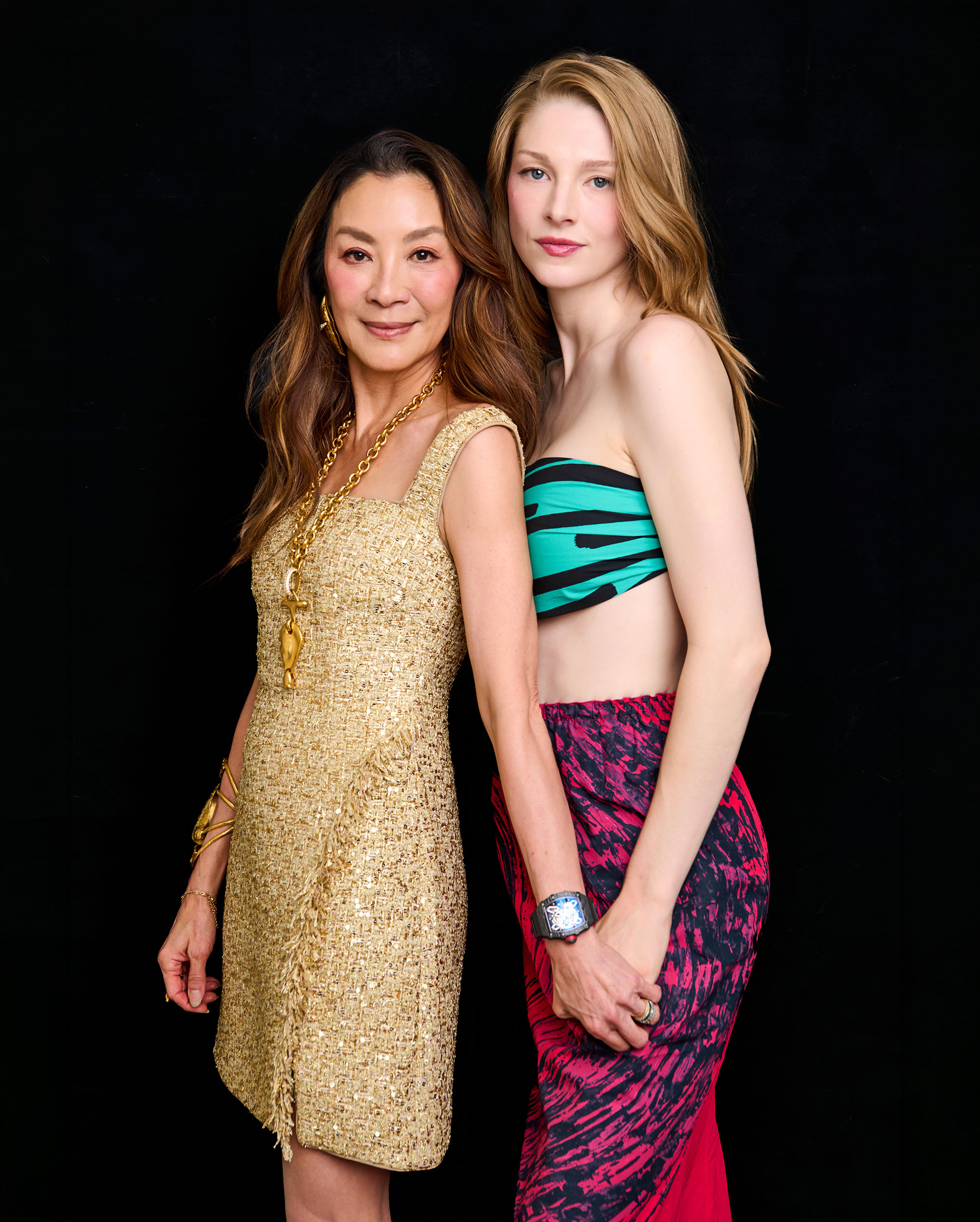
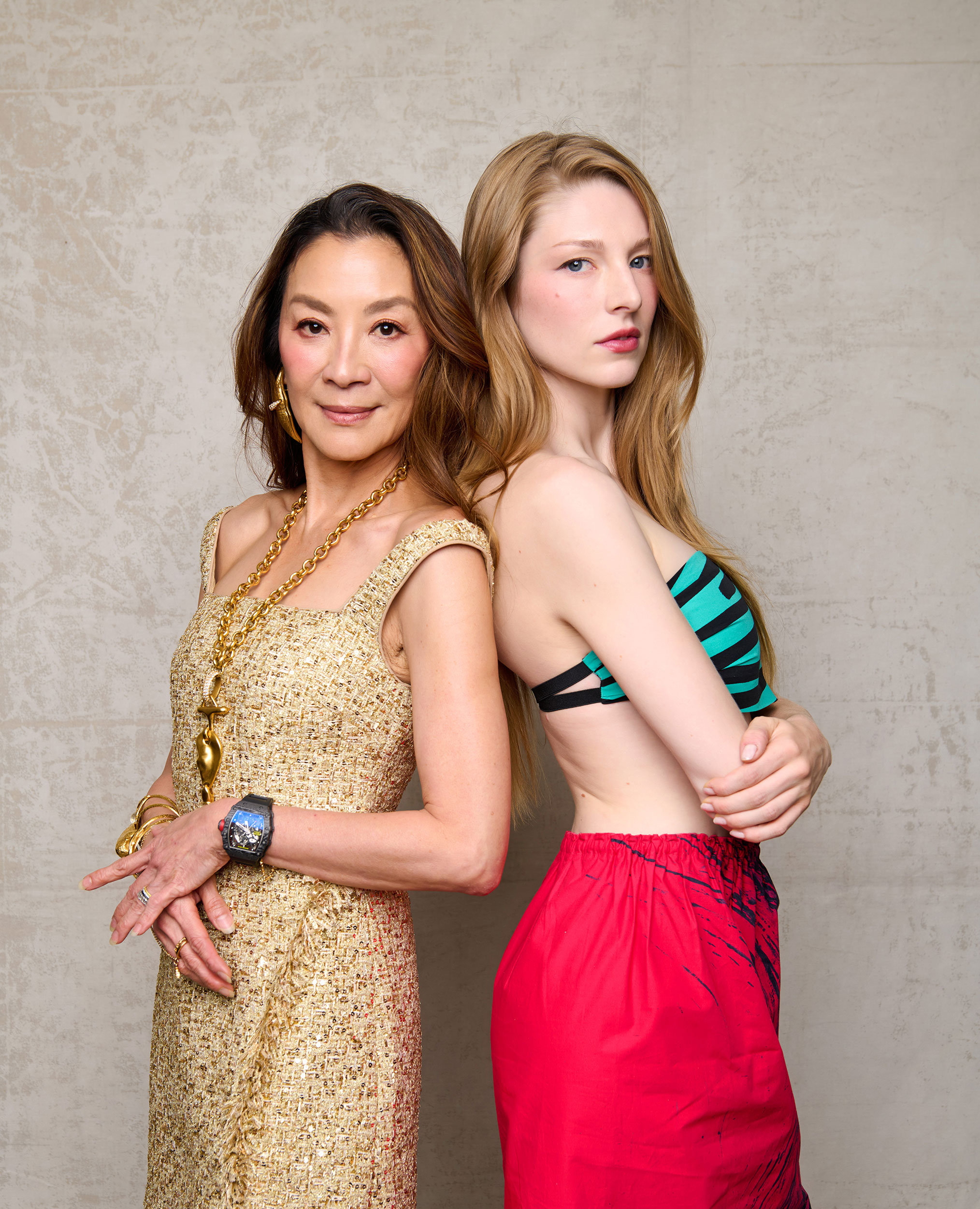
Do androids dream of electric sheep? No idea, but we’re pretty sure that Michelle Yeoh, who plays one in the latest expansion of Philip K. Dick’s sci-fi novel, barely even sleeps. Fresh off a flight from Busan, the Everything Everywhere All at Once Oscar-winner arrived at our New York Comic Con studio last month jet-lagged and REM-deprived, yet joyous to be discussing her new gig as, ironically, an emotionless badass.
“I get to play a bloody replicant!” she enthuses after a hug-filled reunion with costar Hunter Schafer (Euphoria) ahead of their digital cover shoot this October. “[It was] fun in the best way.”
Set 80 years after Blade Runner, Ridley Scott‘s visionary 1982 adaptation of Dick’s novel with Harrison Ford as an ex-LAPD cop in a futuristic 2019 hunting genetically engineered humanoids created by the shadowy Tyrell Corporation and 50 years after its 2018 Ryan Gosling-led sequel Blade Runner 2049, this lavish sci-fi mystery returns to the films’ dystopian Los Angeles, a place that would never be described as “fun.” Natural resources are nil, off-world colonization is our last hope, and a violent uprising has put replicants in charge after decades of enslavement as forced labor. Their former oppressors, humans, now either serve them as the working class or hide in insurgent factions around the city.
“We decided after 2049 to move this to television and in deciding what to do, we are taking into account the entire canon,” explains Broderick Johnson, exec producer and co-founder of Alcon Entertainment, the owners of the Blade Runner IP. “And so the show is driving off of the original film, 2049, the Philip K. Dick book, all of it. It lives harmoniously within all of it.”
“I think what’s important to note about the process though, which is maybe different than other shows or whatever, is [that] we developed what we wanted the show to be internally with Silka Luisa, the showrunner, before we then took it out and set it up with Amazon,” Johnson continues. “Then together with Amazon, we took it further in development to ultimately get a greenlight. So there was a process before Amazon, and then when we ended up at Amazon, at that point, you’re partnering with them and coming up with exactly what the show will be.”
“We have every intention to go back to film, to be clear,” states Johnson’s Alcon co-CEO and fellow EP Andrew A. Kosove. “This is a limited series, but what we liked about doing a TV show, and especially doing it with Amazon, given their extraordinary global reach as a company, is that we thought we could really broaden the fan base for Blade Runner around the globe. And we thought by telling a long-form story, we could delve into character more than you can do in film. That’s the beauty of TV. “
“[They] were very open to hearing all different takes,” raves Luisa, a self-confessed fan of both the features and Dick’s classic. “I came in with the idea of, ‘OK, we’re well past the films, we’re in a new status quo, and the replicants have taken over,’ so what does that do for the franchise and how would we populate that world?”
Matt Doyle
By casting two of today’s most fascinating actors, to start. As Olwen, a replicant Blade Runner with eight days left in her designated lifespan, Yeoh is a study in chilling stoicism. Her Olwen is removed, precise, and pragmatic, but as the episodes play out, we’re led to wonder if a mission from her past has gotten under her synthetic skin. “That’s the question of humanity,” Yeoh notes. “I don’t think you’re born with it. You sort of acquire it along the way.”
For Schafer, more than holding her own opposite the Wicked villain, it was a matter of dispensing with her humanity. To play Cora, a human trying to infiltrate the LAPD in a plot that could finance her escape from the replicant-run country, she had to pass as a soulless replicant while also masking Cora’s deep loathing of the very group responsible for her tragic backstory. “That was one of the fun challenges; there’s these layers of performances,” Schafer notes. “Obviously, we are actors acting as these characters, but then the characters are also acting and kind of acting multiple things at once.”
“Both of them are full of secrets,” echoes a grinning Yeoh.
And their boss is full of love for what they have added to the long-running franchise, which she says “has always been about the human experience and what does it mean to be human.”
“I never actually imagine actors when I’m writing,” Silka confesses, adding that she “won the lotto” with her leading ladies. “It is always interesting once you cast how the roles shift. Something that Hunter brought to Cora, which I hadn’t imagined, was so much heart to the role. She really is the human heartbeat of the show, and Cora’s someone who has been living her life on the run. She’s been stripped of all of her humanity, all of her empathy, and has to make really hard choices. You watch her do that, and you have to be along for the ride with her.”
Clay Enos/Prime Video
“Hunter was able to build in these tiny moments of vulnerability and access to those tough decisions that help you get behind her and root for her,” she says. “That was an additional layer that I think she just did so elegantly.”
As for the hotter-than-ever Yeoh, Silka previews that “she has an incredible arc over the season. In these last days of her life, that really is an opportunity for her to discover humanity, discover her empathy, her being around Cora. Obviously, they’re both hiding a lot. Do they open up to each other? What does that cost them? She really takes us on that journey.”
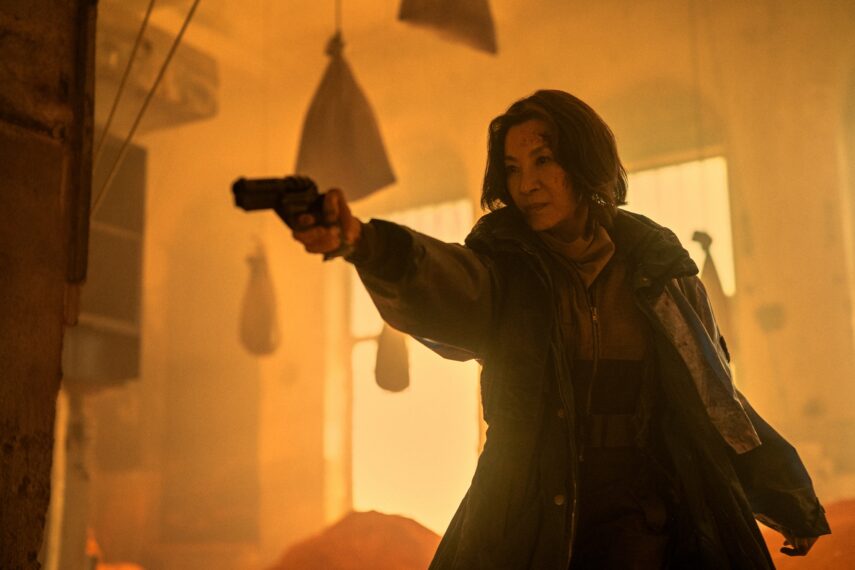
One that begins, as previous Blade Runners have, with a hunt. From the outset, we’re shown that Yeoh’s character is capable of not just handling herself but also handily dispatching troublemaking humans as she and fellow replicant cop Yaya (Matthew Needham) scour the soaking, sweaty Los Angeles for insurgents. Through flashbacks, it’s revealed that she’s also done her time in off-world labor: Her pre-LAPD life was spent in space, setting off explosives to create the atmospheres for planets being terraformed. It’s there that the sparks of something replicants aren’t supposed to exhibit begin to foment, eventually introducing the closest thing to a moral dilemma her kind can face during her final operational days.
“The films have always made replicants the characters that you’re rooting for,” Luisa says of Olwen’s unexpected inner turmoil. “So I was given a template for success because those were always the characters that I connected with most.”
Clay Enos/Prime Video
“Olwen has gotten to a stage where she’s birthed so many stars and moons, and she feels like, ‘I’ve been there, I’ve done that. What is more to do?’” posits Yeoh. “Now suddenly, it’s all upside down with her having to take down a replicant, which is something that they never had to do before. They were only chasing after the useless humans. [It’s] all suddenly became not right.”
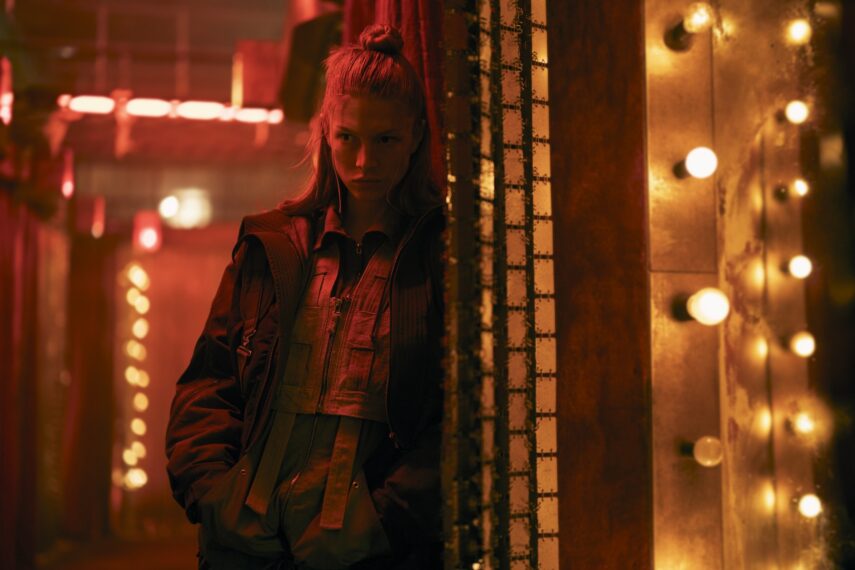
At the same time, Schafer’s resistance-minded Cora is doing her best to protect her disabled brother Elias (Lewis Gribben) while evading the replicant Runners. Her best hope, it turns out, lies in getting closer to them after a black-market dealer named Bobeto (Dimitri Abold) offers her passage to Mexico City, where humans allegedly live with more freedoms. All she has to do is assume the stolen identity of an LAPD replicant and swipe a mysterious package being stored in their evidence hold.
“I think when we first meet her, she’s not happy to have to be joining their ranks,” notes Schafer. “For as long as she’s able to remember, replicants in the position of being a Blade Runner have been enormous sources of pain and trouble in her life. There is this enormous dichotomy between her and her brother and her family as humans versus the replicants. So there is this prejudice that she has accumulated over years and years of pain she’s received from these people.”
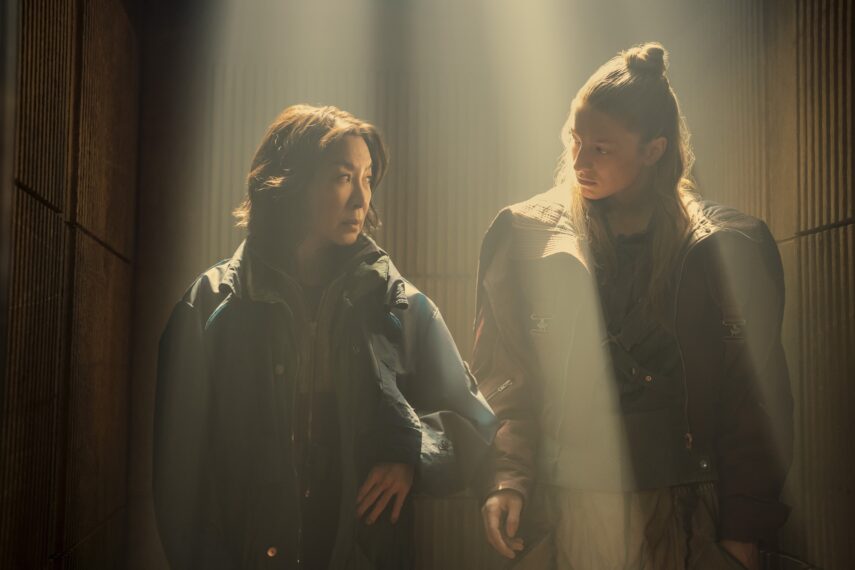
Things get even trickier when Cora is suddenly partnered with Olwen to locate and exterminate the aforementioned rogue Blade Runner, leading to a sort of Replican-ception where a fake human may be hiding real emotions from a real human that’s posing as a fake one. With both women so highly skilled at wearing emotional masks, can either see what’s going on behind the other’s?
Clay Enos/Prime Video
“Once the idea of an undercover story came, it was like, ‘OK, we have more time. We can do a partnership. We don’t have to have a single lens for the show,’ and that’s how the idea for Cora and Olwen came about,” Luisa says. “There’s always been a huge debate [among fans] about what is the difference between a replicant and a human? The most clear way to explore that is to set them side-by-side and examine how they change each other, how they challenge each other, what they give each other and what they lose.”
One thing they haven’t lost in the move from big screen to streaming is the franchise’s dazzling scope and visual effects. From the sweeping score by Shogun’s Leopold Ross to the inspired costuming (Cora’s replicant gear mimics literal armor) to the rain-soaked dread of a decrepit L.A., every shot serves cinematic grandeur. The spinner vehicles are still those flying jalopies Ford first piloted, society is still powered by outdated, analog tech, and the artificial, super-strong lifeforms made of organic materials are as complicated as they were in ‘82. Eagle eyes may even spot a very clever nod to the iconic hairstyle sported by Sean Young’s Rachael. Seconds into the pilot, there is no doubt we are in the world of Blade Runner.
Ironically, for a future where it’s impossible to differentiate between artificial and authentic lifeforms, much of 2099 employed old-fashioned practical sets and locations in Prague and Spain. “Obviously, they did a lot of CGI in post or whatever,” Schafer acknowledges. “But as far as what we were seeing every day, we didn’t have to use our imaginations very much.”
“When we walked onto the set, it was so amazing not to be faced with just green screen all around and go like, ‘What are we imagining here?'” agrees Yeoh.
Matt Doyle
“Our production designer is a man named Paul Ingliss, who was the supervising art director on Blade Runner 2049,” Kosove points out. “Paul is a brilliant, brilliant man and is as knowledgeable about the history of the design of the two films as anybody. So he brought a lot of institutional knowledge and artistic talent and passion to the process from a design standpoint.”
Additionally, Kosove hints that “you will see as the season goes on, Silka took nuggets of ideas from the novel and wove them into the story we’re telling in a really interesting way. So for real aficionados of this IP, they’re in for a super treat because there are concepts in the show that have not been explored in either movie, philosophical concepts that are really interesting.”
“[We] did not believe — nor did Amazon as our partners and the network platform — that this was worth doing at all unless it could be done at an extraordinarily high level,” Kosove asserts. “Because the two movies were at such a high level.”
Well, mission accomplished. Like the Runners that walked before it, this entry is gorgeously grimy, insightful, and endlessly twisty. Especially once Cora and Olwen’s investigation into the company that’s taken over replicant production leads them to suspect one another of hiding truths neither can afford to reveal.
“That tug and pull between the two of them is like whose tooth is coming out first?” Yeoh teases with a devious relish. “And it gets gnarly.”
Blade Runner 2099, Series Premiere, Wednesday, November 25, Prime Video
Conversation
Please read the TV Insider Community Guidelines.
Register or sign in to join the conversation.